Category: Resources & Tools

How We Do It Here June Week One
Resources & ToolsWorking with Dementia

How We Do It Here

A Professional Series on Building Better Dementia Care

June: Dementia-Friendly Environments in Senior Living & Care Settings

Why Environments Matter

At Dementia Life STL, we have the privilege of spending time in many senior living communities, memory care neighborhoods, adult day programs, and care settings throughout our region.

And we want to say something honestly, respectfully, and with tremendous hope:

Very few environments are truly dementia friendly.

Even in memory care.

Even in communities where families are paying thousands of dollars each month specifically for dementia support.

This is not said with judgment.

It is said because we believe our field can do better – and because we know firsthand that when environments improve, resident well-being improves too.

The truth is: many of the challenges communities struggle with every day are deeply connected to environment.

  • Noise
  • Overstimulation
  • Rushed care
  • Cold temperatures and drafts
  • Confusing layouts
  • Unfriendly or task-focused approaches
  • Lack of meaningful engagement
  • Too many instructions at once
  • Institutional pacing instead of human pacing

The environment matters far more than many organizations realize.

And when communities intentionally create dementia-friendly environments, we often see improvements in:

  • Distress behaviors
  • Dining success
  • Activity participation
  • Medication refusals
  • Cooperation during care
  • Sleep patterns
  • Staff stress levels
  • Family satisfaction
  • Overall resident quality of life

Because dementia does not just affect memory.

It affects how a person experiences the world around them.

The Environment Is Either Supporting the Brain – Or Working Against It

As dementia progresses, the brain may struggle to process background noise, busy visual environments, multiple conversations, complicated instructions, overstimulation, unfamiliar spaces, rushed interactions, and unpredictability.

What may feel normal to staff can feel exhausting, frightening, or overwhelming to a resident living with cognitive changes.

And often, what we label as:

  • “Noncompliance”
  • “Attention-seeking”
  • “Agitation”
  • “Wandering”
  • “Refusing care”
  • “Behaviors”

may actually be communication.

The resident may be saying:

“I’m overwhelmed.”

“I’m scared.”

“I’m so cold.”

“There’s too much happening.”

“I don’t understand.”

“I need more time.”

“I don’t feel safe.”

“My brain cannot process this environment.”

This is why dementia-friendly environments are not an “extra.”

They are clinical care.

And they affect nearly every outcome communities care about.

Before Anything Else, The Community Must Decide: “How We Do It Here”

Walk into almost any family home and you will often find signs on the walls that tell you what matters there.

“In this house, we laugh often.”

“Family is everything.”

“Be kind.”

“Gather here.”

“Bless this home.”

Those signs are not really decorations.

They are declarations.

They communicate the values, culture, and expectations of the people who live there.

Senior living communities should be no different.

Before changing lighting, dining rooms, sensory stimulation, routines, or care approaches, organizations first need to decide:

Who are we?

What do we stand for?

How do we want people to feel when they live here, work here, and visit here?

The communities that successfully create dementia-friendly environments almost always have a shared philosophy that sounds something like:

“In our home, we slow down.”

“In our home, residents come first.”

“In our home, emotional safety matters.”

“In our home, we connect instead of correct.”

“In our home, we create calm.”

“In our home, every person is treated with dignity.”

“In our home, relationships matter more than routines.”

“In our home, we work together.”

These statements may never appear on a decorative sign hanging on the wall.

But they should be visible in every interaction.

Because culture is not what an organization says.

Culture is what people experience.

And dementia-friendly care begins long before environmental changes are made.

It begins with deciding:

This is how we do it here.

That culture must come before the environmental changes.

Because without shared buy-in, dementia-friendly care becomes inconsistent from shift to shift, department to department, and person to person.

And yes, there may be pushback at first.

Some staff may say:

“We don’t have time.”

“This is unrealistic.”

“We’ve always done it this way.”

“Families don’t understand staffing challenges.”

“Residents just have behaviors.”

But when teams begin understanding the WHY behind dementia-friendly care, perspectives often begin to shift.

Research has repeatedly shown that person-centered dementia care environments are associated with improved staff satisfaction, reduced burnout, better teamwork, and improved quality of care.

Studies have also shown that staff who feel supported in delivering person-centered dementia care often experience greater professional fulfillment and stronger connection to their work.

And honestly, many caregivers entered this field because they wanted to help people feel safe, valued, and cared for – not simply complete tasks on a schedule.

How To Begin Changing the Environment

The first step is simple:

Include everyone.

Every single person who walks into memory care contributes to the environment residents experience.

Not just nursing.

Not just activities.

Not just leadership.

Everyone.

  • Dining staff
  • Housekeeping
  • Receptionists
  • Maintenance
  • Caregivers
  • Medication technicians
  • Nurses
  • Volunteers
  • Therapy staff
  • Executive directors
  • Agency staff

Everyone should understand:

  • How dementia changes the brain
  • Why environments matter
  • How sensory overload affects residents
  • How pacing and tone affect distress
  • Why residents may react the way they do
  • What supportive dementia care actually looks like

This cannot live only in annual training modules.

It has to become:

“How we do it here.”

Do This Exercise With Your Team

At your next staff meeting or town hall, try this exercise.

Turn on a television.

Play music in the background.

Have multiple staff members talk at once.

Then ask one employee to complete a task they are unfamiliar with while someone gives rapid instructions and corrects them impatiently.

Then add another layer:

Have them wear blurry glasses, sunglasses indoors, or goggles that distort their vision.

Afterward, ask:

“How did that feel?”

Most people describe feeling:

  • Anxious
  • Overstimulated
  • Frustrated
  • Pressured
  • Mentally exhausted
  • Distracted
  • Irritated
  • Confused

Now ask your team:

“What if this was your reality every day?”

That moment creates empathy.

And empathy creates buy-in.

And eventually, ownership and pride in the care being delivered and the community they help create.

Making It Stick: “How We Do It Here”

Dementia-friendly culture must become:

“How we do it here.”

That means:

  • Talking about it during interviews
  • Discussing it in orientation
  • Training consistently
  • Modeling it daily
  • Recognizing staff who do it well
  • Coaching staff who struggle
  • Holding teams accountable

Communities should be very clear during hiring about the type of dementia care culture they are building.

And accountability matters.

If a staff member consistently approaches residents with impatience, harshness, dismissiveness, or rushed care, that cannot simply be overlooked because “the tasks got done.”

Because in dementia care, how care is delivered matters just as much as whether the task was completed.

Families notice.

Residents feel it.

Staff culture reflects it.

And leadership sets the tone.

Start Small – One Change Each Week

Communities do not need to overhaul everything overnight.

In fact, the most sustainable change often happens gradually.

Challenge your team to improve just one thing each week.

Maybe this week:

Televisions are turned off during meals and calendar activities.

Next week:

We make comfort a priority and ensure temperatures are appropriate throughout the community.

The following week:

Staff focus on smiling, slowing down, and approaching residents with a gentle tone.

Then:

We create more predictable daily routines and transitions.

Small environmental shifts can create enormous changes over time.

And staff begin seeing firsthand:

“This really works.”

Become the Local Expert Families Trust

Families today are searching for communities that truly understand dementia.

Not just communities that provide supervision.

Not just communities with locked doors.

Families are looking for environments where their loved one will be understood, comforted, supported, and treated with dignity.

Communities that intentionally build dementia-friendly environments position themselves as leaders in their local area.

Not through marketing slogans.

But through culture.

Through outcomes.

Through resident well-being.

Through family trust.

And ultimately, that is what drives most of us into this field in the first place.

Not just occupancy.

Not just tasks.

But improving quality of life for people living with dementia.

At Dementia Life STL, we would love to help organizations build environments where residents — and staff — can truly thrive.

Because the best dementia care is not something we say.

It’s something people experience.

It’s simply…

How we do it here.

We’d Love to Help

If this article sparked ideas for your team, we’d love to continue the conversation.

Dementia Life STL offers a free Dementia-Friendly Environments Skill Builder and Staff In-Service Packet for organizations looking to begin improving their environment and culture.

We also provide no-cost staff trainings, caregiver education, community presentations, and our immersive Dementia Experience throughout the region.

Whether you’re just getting started or looking to take your dementia care to the next level, we’re here to help.

Reach out anytime – we’d love to connect.

📧 mary@dementialife.care
🌐 www.dementialife.care

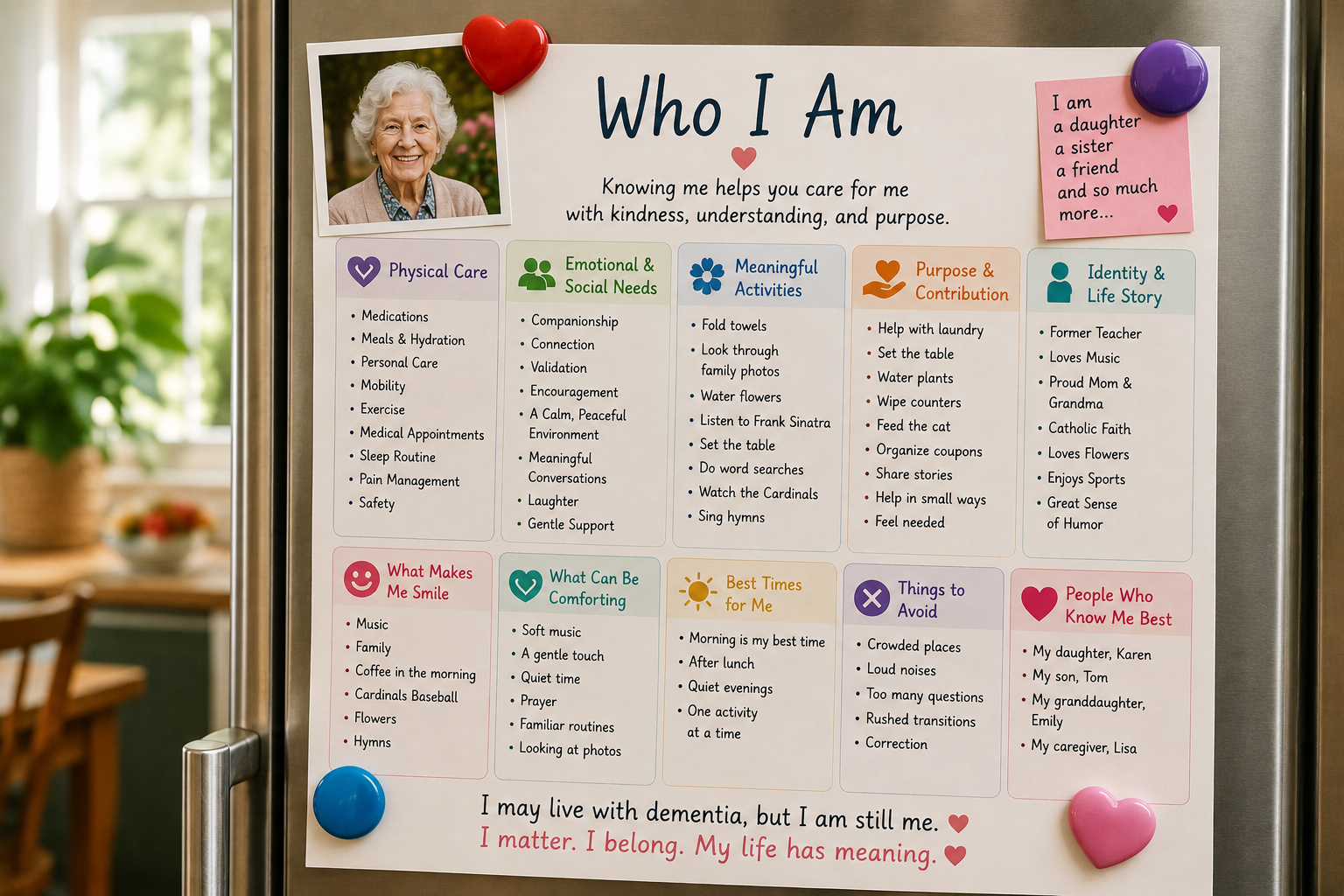
Who I Am
Daily Life & CaregivingEmotional & Spiritual SupportResources & Tools

Planting Purpose: Bringing Meaningful Engagement Into Everyday Life

Over the past several weeks in our May Flowers series, we have explored something we believe deeply at Dementia Life STL:

A meaningful life does not end with a dementia diagnosis.

We have talked about why activities are not simply “something to do.”
We have explored how meaningful engagement supports emotional well-being, reduces distress, and helps a person continue to feel connected to the world around them.

We have learned how to:

  • Adapt activities to match remaining abilities
  • Focus on strengths instead of losses
  • Create person-centered moments rooted in lifelong interests, routines, and identity
  • Preserve purpose, dignity, and joy at every stage of dementia

This week, we want to bring it all together.

Because eventually every family asks the same question:

“Okay… but how do we actually make this happen day to day?”

How do we move beyond good intentions and create a life that truly supports meaningful engagement on a regular basis?

At Dementia Life, our answer is simple:

Meaningful engagement should become part of the care plan – not an afterthought.

Because quality dementia care is about far more than medications, meals, and appointments.

It is about creating a life that still feels like life.


Every Person Living with Dementia Deserves More Than Physical Care Alone

When most people hear the words “care plan,” they think about:

  • medications
  • doctor appointments
  • bathing
  • safety concerns
  • mobility needs

And yes – those things matter tremendously.

But a person living with dementia is still a whole person.

Meeting physical needs keeps someone alive.

Meaningful engagement helps them live.

A truly supportive care plan should include both.


Meaningful Activities Belong in the Care Plan Too

Imagine a daily care plan that looks something like this:

8:00 AM – Breakfast
9:00 AM – Medications
10:00 AM – Fold towels while listening to Frank Sinatra
12:00 PM – Lunch
2:00 PM – Water flowers on the patio
4:00 PM – Look through family photo albums
5:30 PM – Help set the table
7:00 PM – Evening prayer and favorite hymns

This is not “keeping someone busy.”

This is preserving identity.
This is reducing boredom and isolation.
This is helping a person remain connected to familiar rhythms and meaningful roles.

And a care plan that includes those things helps everyone who is involved in the individual’s care have the same goal in mind.


Start Small

You do not have to transform the entire day overnight.

In fact, adding just two intentional, person-centered moments into your loved one’s daily routine is an incredible place to begin.

Ask yourself:

What is one familiar daily task that could help my loved one feel purposeful and included?

And:

What is one hobby, leisure activity, or simple pleasure they would genuinely enjoy?

That’s it.

Maybe it is:

  • folding towels
  • watering flowers
  • helping stir cookie batter
  • setting the table
  • feeding the dog

And maybe their leisure activity is:

  • listening to favorite music
  • sitting outside
  • looking through photographs
  • watching birds
  • reading scripture
  • completing a word search
  • watching an old western

Those moments may seem simple.

But simple does not mean insignificant.


Putting the Thoughts To Paper

Once you begin identifying meaningful activities, familiar routines, and purposeful roles, the next step is straightforward:

Write it down.

It does not need to be fancy.
It does not need to look clinical or professional.

In fact, sometimes the best care plans are the simplest ones.

It might be:

  • a notebook on the kitchen counter
  • a piece of paper taped to the refrigerator
  • a dry erase board
  • a binder shared between family members
  • a simple printed daily routine

What matters most is not perfection – it is having a plan.

When meaningful engagement stays only in our heads, it is easy for it to get lost in the stress and busyness of caregiving.

But when it is written down, it becomes intentional.

A written plan also helps create consistency between caregivers. Spouses, adult children, home care staff, volunteers, respite caregivers, and memory care staff can all better understand what brings comfort, what creates joy, what gives the person purpose, what activities are calming, what routines are familiar, and what helps the day go more smoothly.

Even something as simple as:

“After breakfast, Mary enjoys watering flowers and listening to gospel music”

can help transform the tone of the entire day.


You Do Not Have to Do This Alone

Caregiving can feel incredibly isolating, especially when all responsibility seems to fall on one person.

Invite others in.

Grandchildren can read stories or do crafts.
Church members can visit and sing hymns.
Neighbors can stop by for coffee.
Friends can look through photo albums together.
Volunteers can lead music, games, or art activities.

Sometimes all it takes is one caring visitor, one shared laugh, one familiar song, or one meaningful conversation to brighten an entire day.


If Your Loved One Lives in Assisted Living or Memory Care

Many families worry:

“The staff is already so busy.”

And that concern is understandable.

But families still play an incredibly important role in helping staff understand the person behind the diagnosis.

We encourage families to share:

  • preferred name
  • former occupation
  • favorite music
  • hobbies and interests
  • comforting routines
  • spiritual practices
  • favorite topics
  • activities they dislike
  • best times of day for engagement

The more staff members know about the individual, the more opportunities there are for truly person-centered care.

Families can also help create additional opportunities for engagement by:

  • leading a small music group
  • organizing sing-alongs
  • helping with gardening
  • coordinating intergenerational visits
  • recruiting volunteers
  • donating activity supplies
  • bringing in musicians, students, or community groups

One meaningful activity can ripple outward and touch many residents – not just your loved one.


The Goal Is Not Just Survival – It Is Quality of Life

At Dementia Life, we believe dementia care should never focus solely on preventing decline.

It should also focus on preserving life, connection, identity, and joy.

A strong care plan should answer two equally important questions:

How will we help meet this person’s physical needs?

AND

How will we help this person continue to experience meaning, purpose, comfort, and connection?

Because even in the midst of dementia, meaningful moments are still possible.

And those moments matter.


Need Help Creating a Dementia Care Plan?

If your family would like support creating a personalized dementia care plan, we would be honored to walk alongside you.

Learn more at Dementia Life STL.

Female Doctor Talking with Senior Adult Woman About Hand Therapy.
Daily Life & CaregivingEmotional & Spiritual SupportPersonal Stories & TestimoniesResources & Tools

Learning To Dance: A Nurse’s Journey Into Dementia Care

THE NURSE WHO COULD TALK TO ANYONE 

I’ve always seen myself as someone who connects easily with others. Striking up conversations with strangers, finding common ground with people from all walks of life — it came naturally to me. I prided myself on being nonjudgmental and making others feel at ease, no matter their background or story.  

It’s one of the reasons I felt so drawn to nursing. That ability to build quick trust became one of my greatest strengths as a Registered Nurse. 

WHEN CONFIDENCE TURNS TO UNCERTAINTY 

But when I started working with patients with dementia, something shifted.  

For the first time in my career – maybe in my life – that ease didn’t come so naturally. The connection I had always relied on felt just out of reach. And that was a humbling experience. 

I expected my personality, my training, and my nursing background to be enough. Afterall, I had studied the symptoms. I understood the disease process. I had practiced communication strategies and memorized the medications and treatments used for common behaviors. I was prepared… or so I thought.  

But nothing quite prepared me for the real thing. 

I became rigid. Uncomfortable. Unsure of myself and my actions. I had been taught to speak to and treat my elders in a certain way, and suddenly, none of it seemed to apply. I was in a world of unknowns — and frankly, it baffled me. 

TRAINING ISN’T THE SAME AS EXPERIENCE 

The truth is, no amount of training can fully ready you for the emotional, unpredictable, often tender moments that come with caring for someone with dementia.  

And that’s okay. 

It’s okay if you feel uncomfortable at first. I did, too

I remember second-guessing my words, wondering if I was doing the right thing, feeling overwhelmed when a patient grew agitated or confused. I wanted to fix it. I wanted to connect. And sometimes —despite my best efforts — I felt like I was falling short. 

But what I’ve come to realize over time is this: Caring for someone with dementia is not about perfection. It’s about presence. 

THE MOMENT IT CLICKED 

I remember the exact moment it finally clicked — the moment I truly understood what it takes to work with someone living with dementia.  

I was caring for a patient in a dementia unit at a long-term care facility. She sat in her wheelchair, parked in the hallway, firmly refusing to return to her apartment. After trying every gentle nudge I could think of, I gave in and began changing her wound dressing right there in the hallway. 

As I worked, I heard footsteps approaching from around the corner. A Physical Therapist appeared, guiding another dementia patient beside him. He was trying to teach her how to use her walker safely, but she was growing more frustrated and agitated by the second. 

I paused, curious to see how he would respond. 

Then, something beautiful happened.  

He stopped. He turned to face her, looked into her eyes with calm assurance, and gently took the walker from her hands, setting it aside. 

Then, with a warm smile, he extended his hand and asked: 

“May I have this dance?” 

She giggled — an honest, childlike laugh — and placed her hand in his. And just like that, they began ballroom dancing down the hallway. Not walking. Not redirecting. Dancing. 

They floated down the corridor as staff, visitors, residents, and even physicians watched with wide smiles. Laughter filled the space as they moved together—completely immersed in the moment. 

And that’s when it hit me. 

WHAT I KNOW NOW 

There is no one-size-fits-all approach. What worked for one person on Monday may not work for another on Tuesday. And that’s okay.  

It’s okay to learn as you go. It’s okay to take a breath, to pause, to regroup. It’s okay to make mistakes — and it’s more than okay to forgive yourself for them. 

Because what matters most is that you show up. And that you keep showing up. That you offer kindness, patience, and grace — not just to the person you’re caring for, but to yourself as well. 

CONNECTION BEYOND WORDS 

Working with dementia patients has taught me that connection doesn’t always come from words. Sometimes it’s found in quiet companionship, a gentle touch, or a shared moment of laughter. Sometimes, simply being there — calm, steady, and compassionate — is enough. 

So if you’re new to this, if you’re struggling, if you’re wondering whether you’re doing it “right,” I want you to hear this clearly:  

You are not alone. 

It’s okay to ease into it. It’s okay if it doesn’t come naturally. And it’s absolutely okay to grow into the role over time. 

THE LONG AND WINDING ROAD 

Dementia care is a journey — one of empathy, adaptation, and continuous learning. And if your heart is in the right place, you’re already doing better than you think. 

-Brooke Glenn RN 

bathroom2
Daily Life & CaregivingFamily SupportResources & Tools

Dignity in the Bathroom: Practical Tips for Restroom & Personal Care Challenges in Dementia

Let’s talk about one of the most common, the most difficult, — and the least talked about — challenges in dementia care: bathroom issues.

If you’re helping a loved one who’s forgetting how to use the toilet, having accidents, or resisting help with personal care, you’re not alone. These moments can feel overwhelming — but with the right tools and mindset, they can be managed with compassion, dignity, and even a little humor.

At Dementia Life STL, we’re here for the everyday, behind-the-scenes work that no one sees — but that matters more than words can say.


When the Role Reverses: Caring for a Parent in the Bathroom

Helping a parent with personal care is deeply emotional. You may feel:

  • Awkward
  • Embarrassed
  • Overwhelmed
  • Heartbroken
  • Guilty

You’re stepping into a role reversal most people are never prepared for. You’re doing something intimate and vulnerable — for someone who once did everything for you. That takes incredible strength.

These emotions are normal.

How to Handle the Discomfort

  • Name the feeling – “This is hard” is a valid truth.
  • Pause and breathe – Center yourself before entering the space.
  • Remind yourself of their “why” – The person can’t help the restroom challenges they are facing
  • Remind yourself of your ‘why’ – Love. Loyalty. Compassion.
  • Use humor when appropriate – It can diffuse tension and create connection.
  • Seek help and community – Find others who are also on a journey of caring for someone with dementia and lean on each other.

You are allowed to feel uncomfortable and do the hard thing anyway. That’s courage. That’s caregiving.


Why Bathroom Challenges Happen

Restroom needs often become more complex as dementia progresses:

  • Memory loss – Forgetting where the bathroom is or when to go
  • Mobility issues – Trouble getting there in time
  • Communication – Inability to express the need
  • Visual/spatial changes – Bathroom doesn’t “look right” to them
  • Incontinence – Can increase over time

Sometimes, people simply get distracted or can’t process the signals their body is sending them.


8 Caregiver-Approved Tips That Work

While restroom challenges may never go away, there are some things you as a caregiver can do to make it easier.

1. Create a Routine

We can’t stress enough how important a daily routine is in dementia care! Someone with dementia is typically unable to guide themselves through a path that includes the daily essentials for wellness – nutrition, hydration, movement, and restroom needs. It’s SO important to encourage bathroom visits every 2–3 hours, even if they don’t ask. Try:

  • First thing in the morning
  • Before and after meals
  • Before bed
  • Before leaving the house

When eating, hydration and movement happen close to the same times every day, restroom needs become more predictable too – which will make it easier on everyone involved!


2. Make the Bathroom Easy to Find

  • Leave doors open and lights on
  • Use clear signage with images
  • Consider motion-sensor lights at night

3. Improve Visibility & Comfort

  • Use a brightly colored toilet seat to increase visibility
  • Add non-slip rugs, grab bars, and a raised seat
  • Remove clutter to prevent confusion and distraction

4. Simplify Clothing

  • Elastic waistbands
  • Velcro closures
  • Avoid belts, zippers, and buttons

Quick, easy removal makes success more likely.


5. Use Incontinence Products with Confidence

Adult briefs, pads, or pull-ons can make life much easier. Choose what fits their level of mobility and dignity.

When to Change Briefs:

  • After a bowel movement or major leak
  • Every 2–4 hours during the day
  • At bedtime and first thing in the morning
  • Anytime they feel wet or uncomfortable

How to Change Briefs:

  1. Gather supplies – Gloves, wipes, barrier cream, clean brief, disposal bag
  2. Offer privacy – Close doors, speak reassuringly
  3. Clean thoroughly – Wipe front to back, gently
  4. Check skin – watch for redness, rash, open sores, blisters, skin breakdown in folds or pressure points
  5. Apply barrier cream – Helps protect skin
  6. Dispose discreetly – Use a scented or sealed bag
  7. Wash your hands and breathe – You just did something loving

6. Approach and Respond with Calm and Kindness

Accidents are inevitable, and in these deeply vulnerable moments, it’s so important to prioritize dignity. 

Say:

“Let’s get you cleaned up. You’re okay.”
“It’s no big deal—we’ll take care of it.

Avoid:

  • Shaming
  • Rushing
  • Scolding
  • Showing frustration or disgust

Be mindful of their history. Some individuals living with dementia may have experienced trauma earlier in life — such as abuse, neglect, or assault — that they cannot express or recall clearly. Being touched or exposed during personal care can unknowingly trigger fear or resistance.

That’s why gentleness matters:

  • Announce each step before you do it
  • Ask permission, even if they can’t respond with words
  • Make eye contact and offer reassurance
  • Use slow, calm movements to maintain trust

Your respectful, patient approach helps restore a sense of safety and dignity — especially for someone who may no longer be able to ask for it.


7. Plan Ahead When Out

  • Pack a “go bag” with extras – briefs, wipes, and dry clothing
  • Know restroom locations
  • Use companion cards to discreetly explain behaviors if needed

8. Talk to the Doctor

Significant bathroom changes can signal:

  • UTI
  • Constipation
  • Medication side effects
  • Dehydration
  • Other medical conditions

Keep a care log of changes and concerns, and bring them to the care team.


It’s Not About Control—It’s About Compassion

These challenges aren’t a sign of failure on the part of the person with dementia OR on the part of the caregiver. They’re part of the dementia journey—and you’re doing something extraordinary by showing up with care and consistency.

Every trip to the bathroom, every changed brief, every awkward moment—you are preserving their dignity and meeting a need with love.

That’s what caregiving looks like.


Final Encouragement

This is sacred, quiet work. It’s not always talked about, but it’s deeply human.

If you’ve ever wiped tears while wiping someone clean — you’re not alone.
If you’ve ever felt like you couldn’t do it, then did it anyway — you’re not alone.
If you love someone through the hardest parts — you’re a hero in plain clothes.

At Dementia Life STL, we’re with you. And we’re so proud of you.


👋 Share Your Tips!

Have your own bathroom-care hacks or wisdom to share? Send them to contact@dementialife.care — you never know who you’ll help.