Category: Daily Life & Caregiving

livingroom
Daily Life & Caregiving

When the World Starts to Feel Different: Why Environment Matters in Dementia Care

At Dementia Life, one of the most important things we want families, professionals, and communities to understand is this:

Dementia changes how a person experiences the world around them.

Not just memory.

Not just words.

The world itself may begin to feel different or harder to interpret.

As dementia progresses, the brain may gradually have more difficulty filtering background noise, processing multiple conversations at once, understanding busy environments, recognizing objects, processing information quickly, managing overstimulation, organizing steps and tasks, and understanding what comes next. Things that once felt automatic may slowly begin to require enormous mental effort.

And because of that, the environment itself becomes part of dementia care.

The Brain Is Working Harder Than We Realize

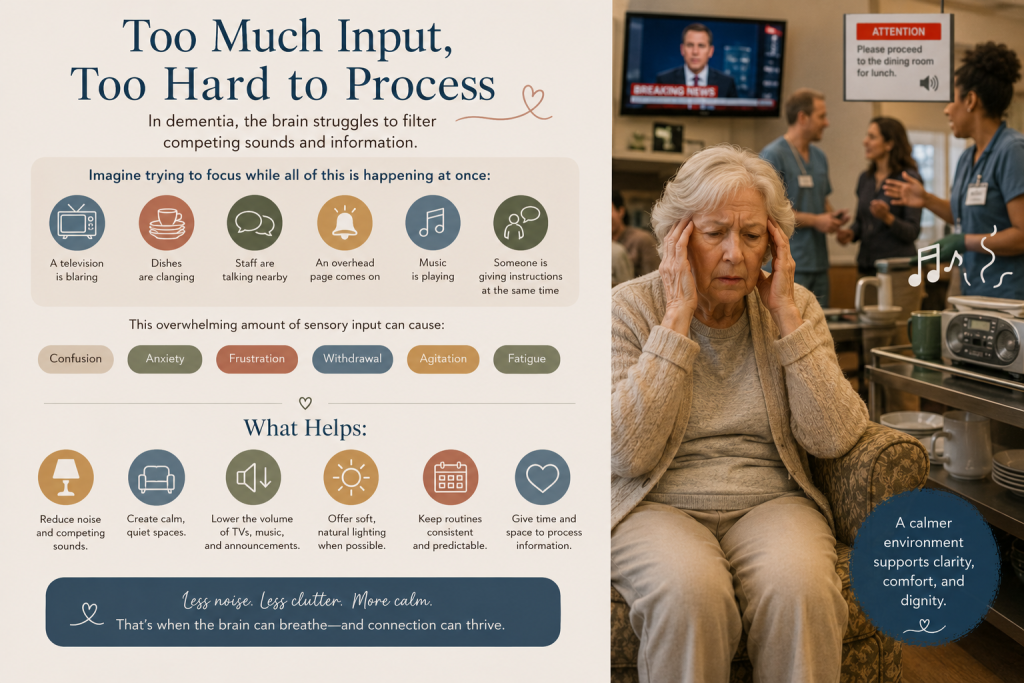
Imagine trying to focus while:

  • a television is blaring
  • dishes are clanging
  • multiple people are talking
  • someone is giving you instructions too quickly
  • bright lights are glaring overhead
  • you are unsure what you are supposed to do next
  • everyone around you seems rushed, impatient, or stressed

Now imagine you cannot fully process or organize all of that information anymore.

For many people living with dementia, this is happening every single day.

The brain is trying incredibly hard to make sense of an environment that may suddenly feel overwhelming, confusing, overstimulating, unpredictable, or emotionally unsafe.

And often, what we call “behaviors” are actually communication.

Sometimes the person living with dementia is saying:

  • “I’m overwhelmed.”
  • “I’m confused.”
  • “I’m cold.”
  • “I don’t understand what you want me to do.”
  • “There’s too much happening around me.”
  • “I’m frightened.”
  • “I’m uncomfortable.”
  • “I don’t feel safe.”
  • “I’m trying my best.”

That changes how we view dementia care entirely.

Because instead of asking:
“How do we stop this behavior?”

we begin asking:
“What is this person experiencing right now?”

An Exercise: Experiencing the World Through a Different Lens

We often encourage caregivers and professionals to try a simple exercise.

Turn on a television.
Then turn on music.
Ask someone nearby to talk to you while you attempt to complete a task you are unfamiliar with.
Now imagine someone giving you instructions quickly while becoming frustrated that you are not keeping up.

Then add another layer.

Put on a pair of goggles, blurry glasses, sunglasses indoors, or anything that changes or limits your vision while trying to complete the task.

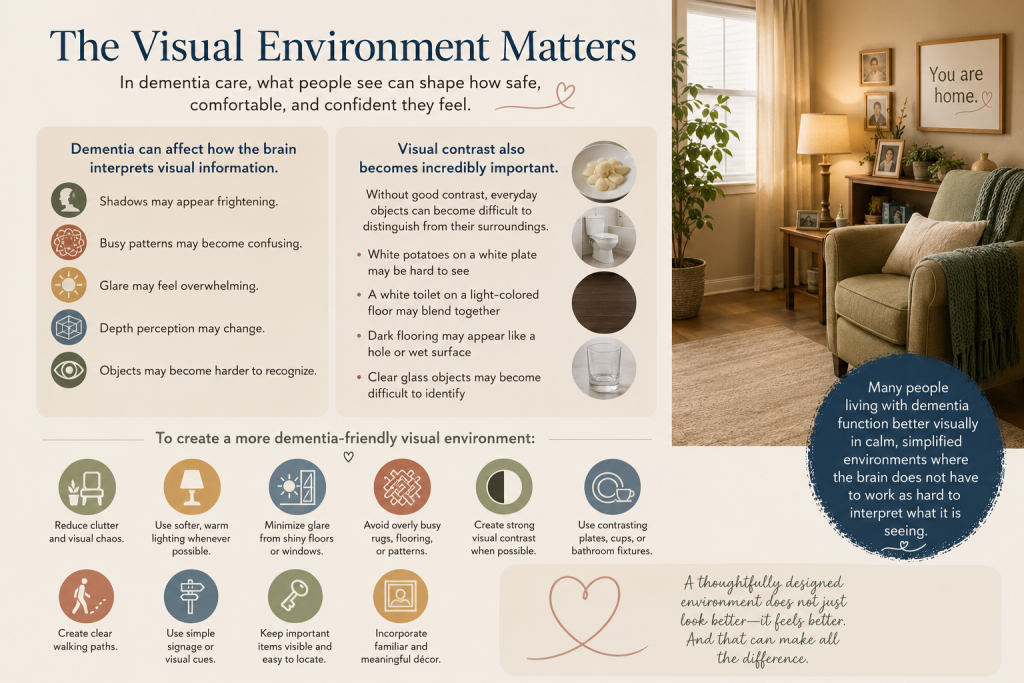
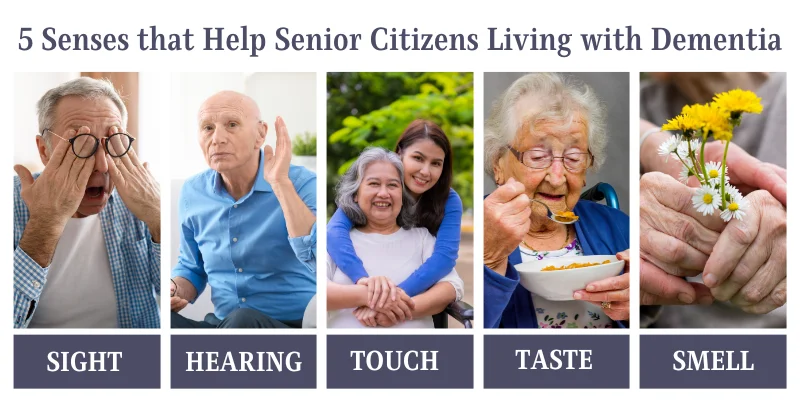
Because dementia can also affect how the brain interprets visual information. Depth perception may change. Shadows may appear frightening. Patterns may become confusing. Objects may be harder to recognize. Glare and lighting may suddenly feel overwhelming.

Most people who try this exercise describe feeling anxious, overstimulated, mentally exhausted, pressured, distracted, irritated, or confused.

Now imagine living with those feelings while also struggling with memory changes, language changes, processing difficulties, or confusion about where you are.

This is why dementia-friendly environments matter so much.

Dementia-Friendly Environments Do Not Happen By Accident

This is incredibly important:

Dementia-friendly environments usually do not happen naturally.

In fact, they are often very different from environments we might naturally create for ourselves.

A person living with dementia may need less noise, slower pacing, simpler surroundings, fewer choices, softer lighting, more predictability, familiar music, reassurance, and calmer conversations in order to feel successful and safe.

Creating a supportive dementia environment requires intentionality.

It means putting the person living with dementia first.

Their comfort.
Their calm.
Their preferences.
Their abilities.
Their emotional safety.

Not what is easiest for everyone else.
Not what feels stimulating to us.
Not what creates the most efficiency.

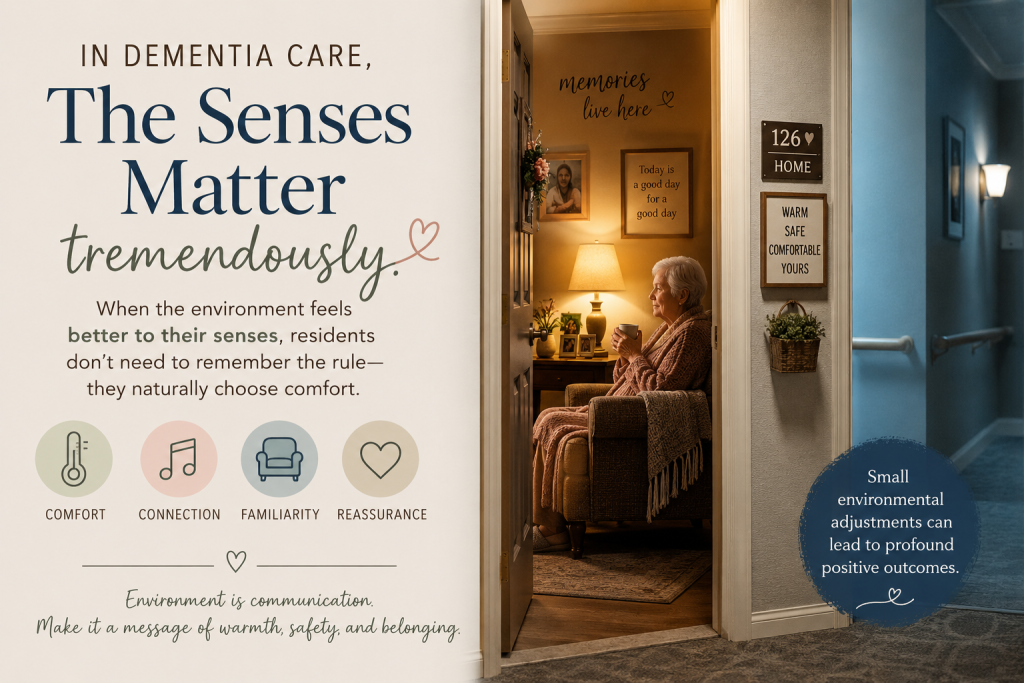
The goal is helping the person living with dementia feel safe, loved, calm, successful, included, respected, and connected – whether at home, in assisted living, memory care, adult day, hospice, home care, or a hospital setting.

Small Changes Can Have a Powerful Impact

Sometimes families feel overwhelmed and assume they must completely transform their home or care setting.

But often, small changes make an enormous difference.

Lowering background noise.
Slowing down communication.
Turning off an overstimulating television.
Offering reassurance before instruction.
Playing familiar music.
Reducing clutter.
Creating predictable routines.
Approaching with a smile.
Making eye contact.
Helping the person feel included and empowered rather than managed.

These things matter more than many people realize.

At Dementia Life, we believe the environment should support the person – not constantly ask the person to struggle to adapt to the environment.

And that shift changes everything.

Over the next few weeks in our Dementia-Friendly Environments series, we are going to take a deeper dive into HOW to make these changes. Together, we will explore how to create environments that are:

  • safe and supportive
  • sensory friendly and calming
  • familiar and easier to navigate
  • full of meaningful cues and routines
  • emotionally supportive and reassuring

Because dementia-friendly environments are not about perfection.

They are about helping a person living with dementia feel safe, successful, understood, and loved.

Putting It Into Practice: This Week’s Action Steps

Action Item #1: Become an Environment Detective

For one day, pay attention to the spaces your loved one spends the most time in.

Ask yourself:

  • Is the television on even when no one is watching it?
  • Are multiple conversations happening at once?
  • Is there clutter competing for attention?
  • Are there loud or sudden noises throughout the day?
  • Are there times when the environment feels rushed, chaotic, or overwhelming?

Write down three things you notice. Don’t worry about fixing anything yet – just observe.

Goal: Begin seeing the environment through the eyes of the person living with dementia.

We Would Love to Help

If you are caring for a loved one at home, or if you are part of a senior living community, home care agency, adult day program, hospice team, healthcare setting, or memory care community, we would love to help you create more dementia-friendly environments.

Because people living with dementia deserve spaces that help them feel safe, understood, supported, and deeply valued.

And sometimes the smallest environmental changes can create the biggest difference in quality of life.

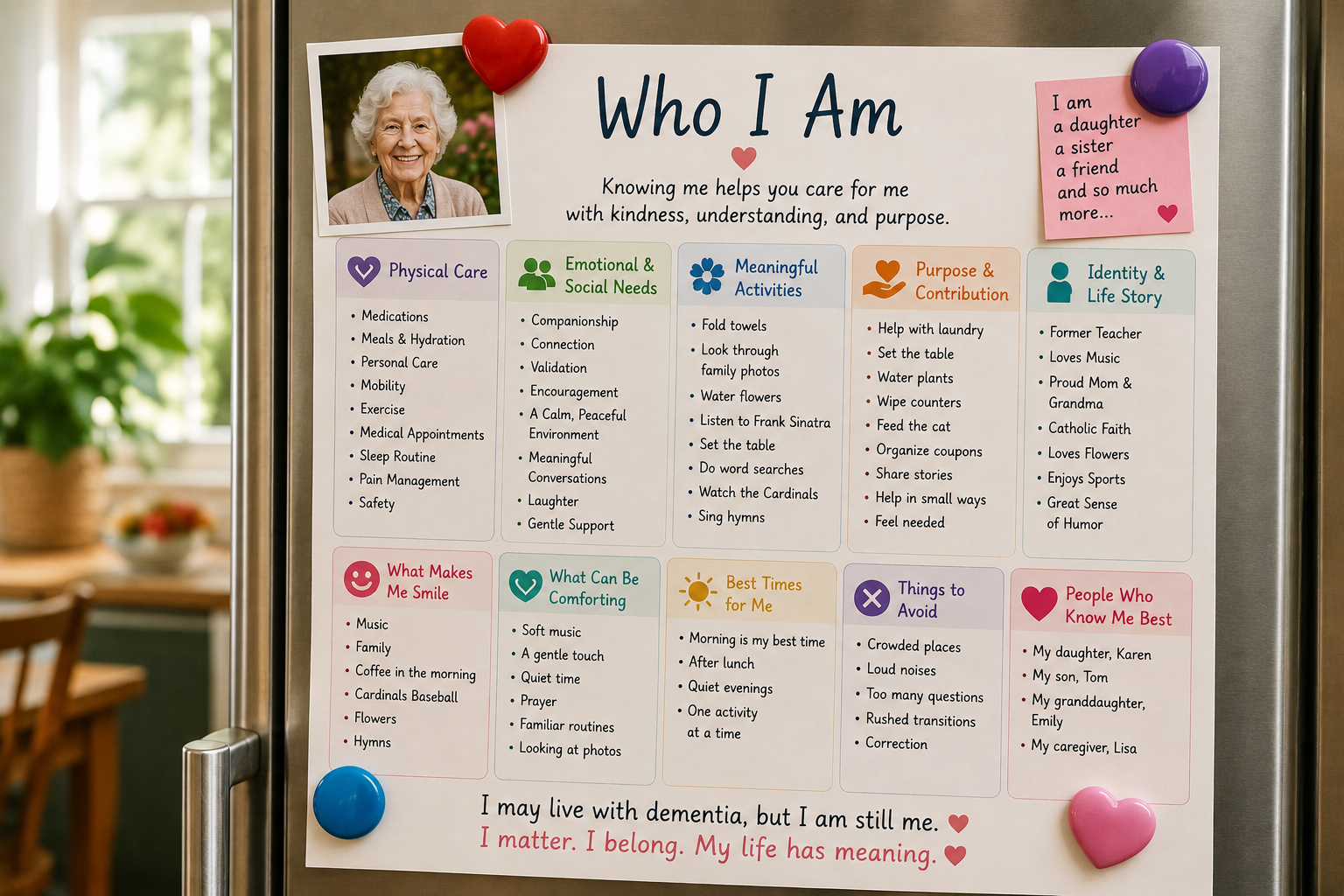
Who I Am
Daily Life & CaregivingEmotional & Spiritual SupportResources & Tools

Planting Purpose: Bringing Meaningful Engagement Into Everyday Life

Over the past several weeks in our May Flowers series, we have explored something we believe deeply at Dementia Life STL:

A meaningful life does not end with a dementia diagnosis.

We have talked about why activities are not simply “something to do.”
We have explored how meaningful engagement supports emotional well-being, reduces distress, and helps a person continue to feel connected to the world around them.

We have learned how to:

  • Adapt activities to match remaining abilities
  • Focus on strengths instead of losses
  • Create person-centered moments rooted in lifelong interests, routines, and identity
  • Preserve purpose, dignity, and joy at every stage of dementia

This week, we want to bring it all together.

Because eventually every family asks the same question:

“Okay… but how do we actually make this happen day to day?”

How do we move beyond good intentions and create a life that truly supports meaningful engagement on a regular basis?

At Dementia Life, our answer is simple:

Meaningful engagement should become part of the care plan – not an afterthought.

Because quality dementia care is about far more than medications, meals, and appointments.

It is about creating a life that still feels like life.


Every Person Living with Dementia Deserves More Than Physical Care Alone

When most people hear the words “care plan,” they think about:

  • medications
  • doctor appointments
  • bathing
  • safety concerns
  • mobility needs

And yes – those things matter tremendously.

But a person living with dementia is still a whole person.

Meeting physical needs keeps someone alive.

Meaningful engagement helps them live.

A truly supportive care plan should include both.


Meaningful Activities Belong in the Care Plan Too

Imagine a daily care plan that looks something like this:

8:00 AM – Breakfast
9:00 AM – Medications
10:00 AM – Fold towels while listening to Frank Sinatra
12:00 PM – Lunch
2:00 PM – Water flowers on the patio
4:00 PM – Look through family photo albums
5:30 PM – Help set the table
7:00 PM – Evening prayer and favorite hymns

This is not “keeping someone busy.”

This is preserving identity.
This is reducing boredom and isolation.
This is helping a person remain connected to familiar rhythms and meaningful roles.

And a care plan that includes those things helps everyone who is involved in the individual’s care have the same goal in mind.


Start Small

You do not have to transform the entire day overnight.

In fact, adding just two intentional, person-centered moments into your loved one’s daily routine is an incredible place to begin.

Ask yourself:

What is one familiar daily task that could help my loved one feel purposeful and included?

And:

What is one hobby, leisure activity, or simple pleasure they would genuinely enjoy?

That’s it.

Maybe it is:

  • folding towels
  • watering flowers
  • helping stir cookie batter
  • setting the table
  • feeding the dog

And maybe their leisure activity is:

  • listening to favorite music
  • sitting outside
  • looking through photographs
  • watching birds
  • reading scripture
  • completing a word search
  • watching an old western

Those moments may seem simple.

But simple does not mean insignificant.


Putting the Thoughts To Paper

Once you begin identifying meaningful activities, familiar routines, and purposeful roles, the next step is straightforward:

Write it down.

It does not need to be fancy.
It does not need to look clinical or professional.

In fact, sometimes the best care plans are the simplest ones.

It might be:

  • a notebook on the kitchen counter
  • a piece of paper taped to the refrigerator
  • a dry erase board
  • a binder shared between family members
  • a simple printed daily routine

What matters most is not perfection – it is having a plan.

When meaningful engagement stays only in our heads, it is easy for it to get lost in the stress and busyness of caregiving.

But when it is written down, it becomes intentional.

A written plan also helps create consistency between caregivers. Spouses, adult children, home care staff, volunteers, respite caregivers, and memory care staff can all better understand what brings comfort, what creates joy, what gives the person purpose, what activities are calming, what routines are familiar, and what helps the day go more smoothly.

Even something as simple as:

“After breakfast, Mary enjoys watering flowers and listening to gospel music”

can help transform the tone of the entire day.


You Do Not Have to Do This Alone

Caregiving can feel incredibly isolating, especially when all responsibility seems to fall on one person.

Invite others in.

Grandchildren can read stories or do crafts.
Church members can visit and sing hymns.
Neighbors can stop by for coffee.
Friends can look through photo albums together.
Volunteers can lead music, games, or art activities.

Sometimes all it takes is one caring visitor, one shared laugh, one familiar song, or one meaningful conversation to brighten an entire day.


If Your Loved One Lives in Assisted Living or Memory Care

Many families worry:

“The staff is already so busy.”

And that concern is understandable.

But families still play an incredibly important role in helping staff understand the person behind the diagnosis.

We encourage families to share:

  • preferred name
  • former occupation
  • favorite music
  • hobbies and interests
  • comforting routines
  • spiritual practices
  • favorite topics
  • activities they dislike
  • best times of day for engagement

The more staff members know about the individual, the more opportunities there are for truly person-centered care.

Families can also help create additional opportunities for engagement by:

  • leading a small music group
  • organizing sing-alongs
  • helping with gardening
  • coordinating intergenerational visits
  • recruiting volunteers
  • donating activity supplies
  • bringing in musicians, students, or community groups

One meaningful activity can ripple outward and touch many residents – not just your loved one.


The Goal Is Not Just Survival – It Is Quality of Life

At Dementia Life, we believe dementia care should never focus solely on preventing decline.

It should also focus on preserving life, connection, identity, and joy.

A strong care plan should answer two equally important questions:

How will we help meet this person’s physical needs?

AND

How will we help this person continue to experience meaning, purpose, comfort, and connection?

Because even in the midst of dementia, meaningful moments are still possible.

And those moments matter.


Need Help Creating a Dementia Care Plan?

If your family would like support creating a personalized dementia care plan, we would be honored to walk alongside you.

Learn more at Dementia Life STL.

setting table
Daily Life & CaregivingEmotional & Spiritual SupportUncategorized

Making Engagement Truly Person Centered

In spring, flowers do not bloom because we tell them to. They bloom when they are given the right conditions: sunlight, nourishment, time, and care.

The same is true for people living with dementia.

Meaningful engagement does not happen simply because we place an activity in front of someone. True engagement happens when we understand who that person is, who they have always been, and what continues to give their life meaning and purpose.

I believe that every person living with dementia remains a whole person with a rich history, enduring preferences, and a deep need for purpose. Dementia changes the brain, but it does not erase identity.

When we make engagement person-centered, we are no longer asking:

“How can we get this person to comply?”

Instead, we ask:

“Who is this person, and what would bring meaning to this moment?”


Why Person-Centered Engagement Matters

Person-centered engagement is rooted in one simple but powerful principle:

People living with dementia are more likely to feel calm, connected, and fulfilled when they are engaged in activities that reflect their identity and life story.

In many cases, behaviors we view as “challenging” are actually attempts to communicate an unmet need.

Often, that unmet need is purpose.


The Deep Human Need for Purpose

Many people living with dementia feel an internal sense that they are supposed to be doing something important.

They may pace.
They may repeatedly ask to “go home.”
They may say they need to “get to work.”
They may become restless or anxious.

These are not random behaviors.

They are often expressions of an inner awareness – what I often call the person’s internal “knower.”

A retired teacher may feel she should be helping others learn.
A father may feel responsible for protecting his family.
A homemaker may feel compelled to keep things orderly.
A mechanic may feel he should be fixing something and using his hands.
A nurse may feel the need to care for others.

The individual may no longer be able to explain what they are feeling, but deep inside, they know they are meant to contribute.

When we provide meaningful roles, we honor this need and help restore a sense of belonging, dignity, and purpose.


Understanding the Whole Person

To create truly person-centered engagement, we must become curious about the person’s life story.

Important areas to explore include:

Past Roles and Identity

How did they see themselves?

  • Mother or father
  • Teacher
  • Farmer
  • Veteran
  • Caregiver
  • Community leader
Hobbies and Interests

What brought them joy?

  • Gardening
  • Fishing
  • Sewing
  • Music
  • Sports
  • Cooking
  • Reading
Culture and Traditions

What customs shaped their life?

  • Holiday celebrations
  • Family recipes
  • Language
  • Ethnic traditions
  • Community gatherings
Spiritual Beliefs

What gave them comfort and meaning?

  • Prayer
  • Worship services
  • Sacred music
  • Scripture readings
Work History

What skills and routines defined their professional life?

  • Managing schedules
  • Repairing equipment
  • Teaching others
  • Organizing paperwork
Daily Routines

What was their usual rhythm?

  • Early riser or night owl
  • Day shift or evening shift
  • Re-entering the home after a day’s (or night’s) work
Personality

Were they:

  • Outgoing or private?
  • Structured or spontaneous?
  • Humorous or serious?
  • Independent or collaborative?
Preferences

What did they consistently enjoy—or avoid?

Sensory Likes and Dislikes

What sensory experiences brought comfort, and which ones caused distress?

Current Abilities

What can they still do successfully with or without support?

Best Time of Day

When are they most alert, calm, and engaged?


Creating Meaningful Roles

One of the most powerful ways to support someone living with dementia is to give them a purposeful role.

This role should feel familiar and meaningful – not artificial or childish.

Meaningful roles draw from the person’s lifelong responsibilities, routines, and strengths.

Examples of Meaningful Roles at Home
  • Folding laundry
  • Sorting mail
  • Watering plants
  • Setting the table
  • Matching socks
  • Organizing photos
  • Stirring ingredients
Examples in Assisted Living or Memory Care
  • Welcoming other residents
  • Delivering napkins
  • Helping arrange flowers
  • Organizing activity supplies
  • Reading aloud
  • Leading songs or prayers

These tasks may seem simple, but to the individual they can represent something profoundly important:

“I still matter.”
“I still contribute.”
“I still have a purpose.”


Real-Life Examples

The Homemaker

A woman who spent decades caring for her family became anxious each afternoon. When staff invited her to fold towels and organize linens, she became noticeably calmer.

The Teacher

A retired educator often corrected others and became frustrated. Giving her books to look through and papers to organize allowed her to reconnect with her lifelong identity.

The Farmer

A lifelong farmer paced and asked to go outside. Providing seed catalogs, potted plants to water, and opportunities to spend time outdoors significantly reduced his restlessness.

The Nurse

A former nurse frequently followed other residents in an effort to help them. Instead of discouraging this, staff invited her to assist with comfort rounds and hand out blankets.


Matching Engagement to Current Abilities

Person-centered engagement is not about asking someone to do what they used to do exactly as before.

It is about adapting activities to match what they can do today.

The goal is the experience, not perfection.

A former accountant may no longer balance books but may enjoy sorting papers.
A gardener may no longer manage a large yard but can water a few plants.
A cook may no longer prepare meals independently but can stir batter or arrange ingredients.

Abilities remain throughout every stage of dementia. Our role is to identify those remaining abilities and create opportunities for meaningful participation.


Practical Questions to Ask

When planning engagement, consider:

  • Who has this person always been?
  • What responsibilities gave them meaning?
  • What skills remain intact?
  • What brings comfort and joy?
  • What time of day are they most successful?
  • What role can they still fulfill today with adaptation and support?

A Garden Still in Bloom

Dementia changes many things, but it does not eliminate the human need to feel useful, connected, and valued.

When we learn a person’s story and create opportunities that reflect their identity, we help them continue to bloom – to remain an active part of their world rather than merely existing in ours.

A folded towel.
A watered plant.
A set table.

These moments may appear ordinary, but they carry extraordinary meaning.

Because beneath the cognitive changes, the person is still there.

Still capable of contributing.
Still longing for purpose.
Still deserving of dignity.
Still blooming.

man sanding wood
Daily Life & CaregivingWorking with Dementia

From “Can’t Do” to “Can Do”: Adapting Activities in Dementia Care

Last week, we talked about bringing life into the day through engagement.

This week, we take that one step further.

Because one of the biggest mindset shifts in dementia care is learning to move from:

“They can’t do that anymore.”

to:

“How can we help them still participate?”

And that shift changes everything.


🌱 The Problem With a “Can’t Do” Lens

It’s understandable.

As dementia progresses, we naturally notice the things that have changed:

  • Tasks take longer
  • Steps are forgotten
  • Safety becomes a concern
  • Activities may no longer look the same

And over time, it becomes easy to begin removing activities altogether.

But when we automatically assume someone can’t do something, we often unintentionally take away:

  • Purpose
  • Independence
  • Identity
  • Confidence
  • Opportunities for connection

In dementia care, the goal is not perfection.

The goal is participation.

Because even when abilities change, there are almost always remaining abilities we can support.

And yes—it may look different now.

But different does not mean meaningless.


🌿 Success May Look Different

This is important:

A person with dementia does not need to complete an activity perfectly for it to be worthwhile.

Success might be:

  • Stirring instead of cooking the entire meal
  • Sanding wood instead of building the full project
  • Folding one towel instead of an entire basket
  • Listening to music instead of singing every word

When we shift our expectations, we often rediscover what is still possible.


🌼 Adapting Activities Across Different Stages

Every person is unique, and dementia does not follow a perfect formula.

But generally, there are ways individuals at every stage can still participate meaningfully.

The key is learning to recognize and support the abilities that remain.


🌱 Early Stage Dementia

In early stages, many individuals still have a wide range of abilities.

They may still:

  • Read and follow written instructions
  • Carry conversations well
  • Complete familiar tasks independently
  • Use fine motor skills successfully
  • Follow one- or multi-step directions
  • Problem solve, though sometimes more slowly
  • Maintain hobbies and routines with mild support

The focus here is often:

  • Simplifying complexity
  • Reducing overwhelm
  • Supporting confidence and independence

Helpful adaptations may include:

  • Breaking large projects into steps
  • Using written reminders or visual cues
  • Allowing extra time
  • Reducing distractions
  • Organizing materials ahead of time

Examples:

  • Gardening with a simplified task list
  • Cooking with ingredients pre-organized
  • Woodworking with setup and safety assistance
  • Sewing or crafting with extra time
  • Participating in household responsibilities
  • Card games with simplified rules

The goal is not to take over.

It’s to support success while preserving independence.


🌿 Middle Stage Dementia

In middle stages, abilities are changing, but many meaningful abilities still remain.

Individuals may still:

  • Follow simple one-step directions
  • Mimic or copy demonstrated actions
  • Participate in repetitive motions
  • Use gross motor skills
  • Engage socially and emotionally
  • Recognize familiar objects and routines
  • Respond strongly to music, rhythm, and sensory experiences

At this stage, activities often need more structure, cueing, and hands-on support.

Helpful adaptations may include:

  • Giving one direction at a time
  • Demonstrating instead of explaining
  • Handing items one at a time
  • Reducing choices
  • Focusing on repetitive or rhythmic tasks
  • Prioritizing familiarity over novelty

Examples:

  • Folding towels
  • Stirring batter
  • Sanding wood pieces
  • Sorting tools, screws, or hardware
  • Watering plants
  • Matching socks
  • Singing familiar songs
  • Walking outdoors
  • Simple art or painting activities

At this stage, the experience matters more than the finished product.


🌸 Late Stage Dementia

In later stages, abilities become more sensory, emotional, and relational.

And this is where many people mistakenly assume activities are no longer possible.

But meaningful engagement can still happen every day.

Individuals may still:

  • Respond to touch and tone of voice
  • Experience comfort through familiar sensory input
  • Enjoy music and rhythm
  • Feel emotional connection
  • Engage visually with movement, color, or nature
  • Participate through hand-under-hand guidance
  • Express pleasure, calm, or discomfort

The focus becomes:

  • Comfort
  • Sensory connection
  • Emotional familiarity
  • Presence
  • Human connection

Helpful adaptations may include:

  • Hand-under-hand assistance
  • Music and singing
  • Gentle movement
  • Familiar textures and scents
  • Short, calming interactions
  • Quiet one-on-one engagement

Examples:

  • Holding warm towels
  • Listening to favorite music
  • Smelling baked goods or fresh-cut wood
  • Touching soft fabrics
  • Watching birds outdoors
  • Hand massage with scented lotion
  • Tapping along to rhythm
  • Sitting beside someone while they participate

At this stage, connection is the activity.


🌼 Putting It Into Practice

Example: Baking

A person may no longer be able to independently bake a cake from start to finish.

But that does not mean baking is gone.

A “can do” approach asks:
What parts are still possible?

Early Stage

  • Reading the recipe together
  • Gathering ingredients
  • Measuring and mixing with reminders

Middle Stage

  • Pouring pre-measured ingredients
  • Stirring batter
  • Placing liners in muffin tins
  • Rolling dough

Late Stage

  • Smelling vanilla or cinnamon
  • Feeling the texture of dough
  • Listening to kitchen sounds
  • Tasting the finished product
  • Sitting nearby while participating socially

The activity changes.

But the meaning, familiarity, and connection can remain.


Example: Woodworking

A lifelong woodworker may no longer safely operate power tools.

But woodworking itself does not have to disappear.

Early Stage

  • Smaller supervised projects
  • Organizing tools
  • Measuring and sanding

Middle Stage

  • Sanding wood pieces
  • Sorting nails or hardware
  • Holding materials during projects
  • Feeling different textures of wood

Late Stage

  • Smelling sawdust or wood stain
  • Holding smooth pieces of finished wood
  • Watching others work
  • Talking about past projects

Again – the goal is not perfection.

It’s preserving identity, purpose, and connection.


💬 Final Thought

A dementia diagnosis changes abilities.

But it does not erase the human need for purpose, participation, and meaning.

When we shift from:
“They can’t do this anymore.”

to:
“How can we help them still be part of this?”

…we begin to create care that empowers instead of limits.

And often, we discover far more is still possible than we first imagined.

shower 1
Daily Life & Caregiving

Guiding, Not Forcing: Bathing in Dementia Care

Over the past two weeks, we’ve talked about two essential foundations:

First – knowing your person: their routines, preferences, comfort, and history.
Second – preparing the environment: making the space warm, safe, calm, and supportive.

This week, we bring it all together.

Because even when you know your person…
Even when the environment is just right…

How we approach and guide the bathing process itself matters deeply.


A Gentle Shift in Mindset

Before we talk about the “how,” it’s important to ground in this:

We are not doing a task to someone.
We are guiding someone through an experience.

An experience that can feel:

  • Vulnerable
  • Confusing
  • Overstimulating
  • Or even frightening

Our role is to reduce fear, build trust, and move at the pace of safety.


Start With How You Approach

The first few moments set the tone for everything that follows.

Use guiding statements instead of questions

Questions can feel overwhelming or easy to refuse.

Instead of:

  • “Do you want to take a shower?”

Try:

  • “It’s time to get freshened up. I’ll help you.”
  • “Let’s head to the bathroom together.”

👉 This reduces decision-making and creates a sense of gentle direction.


Use gentle incentives when helpful

Sometimes a small motivator can make a difference.

  • “Let’s get cleaned up before lunch.”
  • “You’ll feel so good in your clean clothes.”
  • “We’ll listen to your favorite music while we get ready.”

👉 The goal is encouragement – not pressure.


Protect Dignity at Every Step

Keep the person covered

Being fully undressed can feel extremely vulnerable.

  • Use towels, robes, or a shower cape
  • Only uncover one area at a time
  • Wash under a towel when possible

👉 Modesty and dignity are not small details – they are essential.


Think About How the Water Feels

Be mindful with water – especially over the head

For many people with dementia, water pouring over the head can feel like they are choking or unable to breathe.

  • Avoid direct water over the face
  • Use a washcloth for the face instead
  • Tilt the head back gently if rinsing hair
  • Consider washing hair separately if needed

👉 What feels routine to us can feel frightening to them.


Keep feet grounded

A sense of stability matters.

  • Encourage keeping feet flat on the shower floor
  • Avoid unnecessary repositioning
  • Use a shower chair if needed

👉 Feeling grounded helps reduce fear and disorientation.


Support Independence Whenever Possible

Even small moments of independence matter.

  • Hand them the washcloth
  • Guide their hand rather than doing it for them
  • Invite participation in simple steps

👉 This preserves dignity and can reduce resistance.


Use Simple, Supportive Communication

Give one-step verbal cues

Avoid overwhelming with too much instruction.

  • “Hold this.”
  • “Wash your arm.”
  • “Step forward.”

Repeat and reassure

The brain may not retain the first instruction.

  • Use calm repetition
  • Keep your tone steady and kind

Narrate as you go

Let them know what is happening – before it happens.

  • “I’m going to wash your arm now.”
  • “You’ll feel the warm water on your back.”

👉 This prevents surprise – and surprise can trigger fear.


Start Where It Feels Safest

Begin with less personal areas

Start with arms, hands, and legs before moving to more sensitive areas.

👉 This helps build comfort and trust gradually.


Give Them Something to Hold

Having something in their hands can be grounding.

  • A washcloth
  • A towel
  • A grab bar

👉 This can reduce anxiety and provide a sense of control.


Watch the Person, Not Just the Task

Your best guide is not a checklist – it’s the person in front of you.

Look for signs of:

  • Discomfort
  • Fear
  • Fatigue
  • Overstimulation

And when you see them – pause.

👉 Slowing down often helps more than pushing through.


A Few Additional Tips That Matter

  • Speak from the front – avoid approaching from behind
  • Maintain eye-level when possible
  • Use a calm, reassuring tone
  • Be flexible – what works one day may not work the next
  • If it’s not going well, it’s okay to stop and try again later

👉 Success is not measured by completion – it’s measured by how the person feels.


Bringing It All Together

When we combine:

  • Knowing the person
  • A supportive environment
  • A gentle, guided approach

We often see:

  • Less resistance
  • Less fear
  • More cooperation
  • More moments of connection

The Goal Is Not the Shower

It’s easy to focus on getting through the task.

But the true goal is something deeper.

To help the person feel:
Safe. Respected. Comfortable. Cared for.


Know this:

The way you show up in these moments matters more than you realize.

Your patience.
Your gentleness.
Your willingness to meet them where they are.

This is meaningful work.
This is sacred work.

We see you.
And we honor you. 💛

Showerhead
Daily Life & Caregiving

Before the Bath: Why the Environment Matters in Dementia

Creating a Bathroom That Feels Safe in Dementia Care

Last week, we talked about why bathing can feel so difficult in dementia.

This week, we shift to solutions – beginning with creating a dementia-aware environment.

Because before we approach the individual, before we begin the task, we have to consider what the space – the bathroom – feels like.

A dementia-aware environment is one designed around the person living with dementia – not around what we might typically prefer or choose.

And sometimes, that means it may feel a little different for us as caregivers.

But when the environment feels right to them, everything else becomes easier.


What Does “Dementia-Aware” Really Mean?

A dementia-aware environment supports how the brain is now processing the world.

It feels:

  • Safe
  • Predictable
  • Calm
  • Comfortable
  • Respectful
  • Guiding and cueing

In dementia, the brain is working harder to make sense of surroundings. What once felt simple can now feel confusing, overwhelming, or even threatening. The person may no longer be able to express their discomfort with words – and may communicate it through resistance instead.

When we reduce confusion and increase comfort, we can greatly reduce distress.


Step 1: Start with Warmth & Physical Comfort

No one wants to remove their clothing in a cold room – but so often, we ask the person we are caring for to do exactly that.

For someone living with dementia, this discomfort can feel extremely overwhelming.

What’s happening in the brain:
Changes in sensory processing (often involving the parietal lobe) can make a person more sensitive to temperature and physical sensations. The brain may also struggle to regulate comfort in the same way it once did.

What helps:

  • Warm the bathroom ahead of time – make sure it is warmer than the room they are coming from
  • Plan to use multiple towels – warm ones are even better (more on this next week!)
  • Ensure the water pressure is not too strong – it can feel like painful needles on the skin

👉 You may feel a little overheated – and that’s okay.
The goal is their comfort.


Step 2: Ensure Good Lighting and Contrast

Lighting is not just about visibility – it’s about understanding.

What’s happening in the brain:
Damage in areas responsible for visual processing and spatial awareness can make shadows look like holes, objects appear distorted, or depth difficult to judge.

What helps:

  • Use bright, even lighting
  • Reduce shadows and dark corners
  • Make edges (like the tub or step) easier to see using colored tape or adhesive strips
  • Use contrast – similar colors can blend together (for example, white soap on a white shelf can be difficult to see)

👉 Good lighting and contrast help the brain feel more certain – and less afraid.


Step 3: Create Familiarity

Familiar sensory experiences can be incredibly grounding for someone with dementia.

What’s happening in the brain:
While short-term memory is often impaired, long-term and emotional memory can remain stronger. The brain may not remember what is happening – but it can remember how something feels.

What helps:

  • Use their favorite soap, shampoo, or scents
  • Play familiar, calming music (if they’ve always enjoyed it)
  • Keep textures (towels, washcloths) consistent
  • Bathe at a time of day that aligns with their lifelong routines

👉 Familiarity creates a sense of: “I know this. I’m okay.”


Step 4: Help Them Focus – Reduce Distractions

A busy environment can quickly become overwhelming.

What’s happening in the brain:
A healthy brain can choose what to focus on. A brain with dementia struggles to filter out unnecessary stimuli. Background noise, multiple voices, or clutter can feel chaotic instead of ignorable.

What helps:

  • Turn off TVs or loud background noise
  • Limit the number of people present
  • Keep the space simple and uncluttered
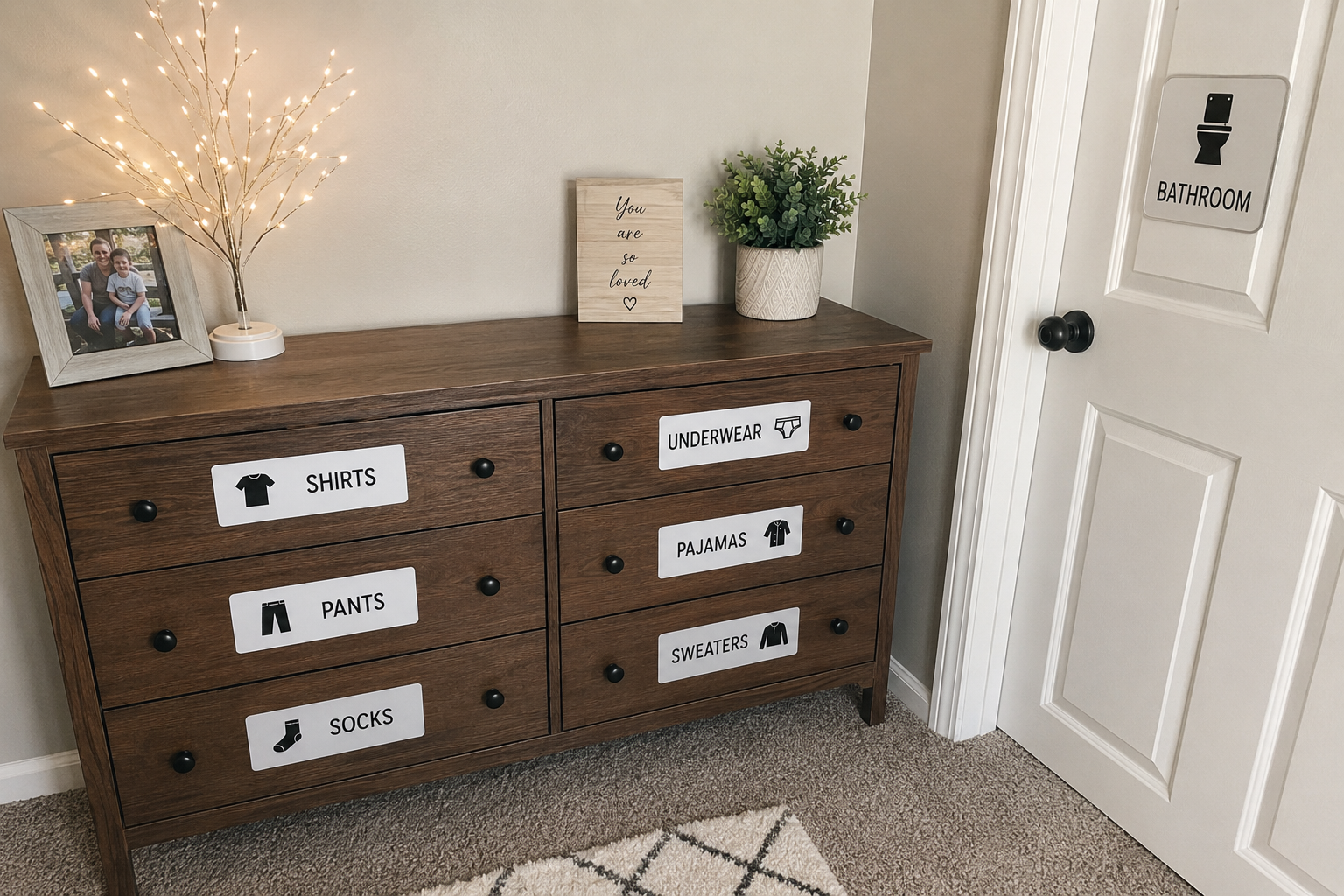
  • Clearly label items in a readable font (if reading abilities remain)
  • Preserve modesty by closing curtains or doors

👉 A calm environment supports a calmer response.


Step 5: Create a Safe Space

If the space doesn’t feel physically safe, it won’t feel emotionally safe.

What’s happening in the brain:
Changes in the parietal lobe and cerebellum can affect balance, depth perception, and body awareness. The person may feel unsteady or unsure of where their body is in space.

What helps:

  • Non-slip mats or flooring
  • Clear pathways (no trip hazards)
  • Grab bars for stability
  • A shower chair or bench
  • A handheld showerhead (for greater control and comfort)

👉 These supports don’t just prevent falls – they reduce fear.


Step 6: Set Up Before You Begin

Preparation makes everything smoother.

What’s happening in the brain:
The brain’s ability to sequence and problem-solve (frontal lobe) is impaired. Pausing mid-task to search for items can create confusion and disrupt the flow. You may also need a free hand to physically support your loved one.

What helps:

  • Have towels, clothes, and a fresh brief set out
  • Have soap, shampoo, and supplies ready
  • Adjust water temperature in advance
  • Keep everything within reach

👉 Fewer interruptions = less confusion.


Step 7: The Most Important Part of the Environment

It’s not the lighting.
It’s not the temperature.
It’s not even the setup.

It’s how the space feels emotionally.

What’s happening in the brain:
The amygdala – the part of the brain responsible for fear and emotional response – often becomes more reactive in dementia. At the same time, reasoning and logic become less accessible.

This means the person is not analyzing the situation logically.
They are feeling it.

So ask yourself:

Does this space feel:

  • Calm?
  • Kind?
  • Unhurried?
  • Safe from pressure or judgment?

Or does it feel rushed… tense… overwhelming?

Does the person feel “in trouble” because their hygiene has declined or they’ve had an incontinence episode?

Think for just a moment about what we are asking them to do…

To undress.
To be exposed.
To rely on someone else.
To be in a place of profound vulnerability.

Your tone of voice.
Your facial expression.
Your words.
Your pace and presence.

These shape the emotional environment more than anything else.


Why This Matters So Much

When we get the environment right, we often see:

  • Less resistance
  • Less fear
  • More cooperation
  • A smoother experience for everyone

Because the goal is not just a successful shower.

The goal is a person who feels:
Safe. Accepted. Loved. Valued.


Next week, we’ll talk about how to approach the bathing process itself – what to say, what to avoid, and how to guide each step in a way that builds trust instead of fear.

Know this:

The work you are doing matters.
It is meaningful.
It is deeply important work.

We see you.
And we honor you.

Caring moment in the bathroom
Daily Life & Caregiving

Why Bathing Is So Hard In Dementia

If you ask caregivers what part of dementia care is the hardest, many will not say memory loss.

They will say bathing and personal care.

This is where we often see the most resistance – fear, anger, and distress. It happens in care communities and in homes alike, and it can feel incredibly frustrating… and deeply concerning.

If this is something you’re facing, it matters to say this clearly:

You are not doing anything wrong.
And they are not trying to be difficult.

They are responding to how their brain is processing the situation.

When we understand what dementia is doing to the brain, these moments begin to make more sense – and we can respond in a way that feels calmer and more supportive for everyone involved.


Understanding the Brain First

The Hippocampus: Memory & Understanding What’s Happening

The hippocampus helps us form new memories and understand what is happening in the present moment. In many types of dementia, this area is affected early.

This means a person may:

  • Not remember if they already showered
  • Not understand why you are asking them to shower
  • Not remember that they need to shower
  • Not recognize the bathroom as a place to bathe
  • Not recognize the person helping them

So when we say,
“It’s time for a shower,”

Their brain may be thinking:
Why? I already did.
Who are you?
What’s happening?

From their perspective, this can feel confusing – or even frightening.


The Amygdala: Fear & Emotional Response

The amygdala controls fear and emotional reactions. In dementia, this part of the brain often becomes more active, while reasoning and logic become less accessible.

This means a person may:

  • Feel scared more easily
  • Misinterpret what is happening
  • Feel embarrassed or exposed
  • Feel like they are in trouble
  • Feel forced or threatened
  • React emotionally rather than logically

This is why bathing can trigger:

  • Refusal
  • Yelling or crying
  • Hitting or pushing away
  • Trying to leave
  • Shutting down

The behavior is not the problem.

It is a response rooted in fear and self-protection – just as any of us might react if we felt unsafe or unsure.


The Frontal Lobe: Sequencing & Following Steps

The frontal lobe helps us plan, sequence, and complete tasks.

And bathing is not one simple task – it is many steps.

Think about what it involves:

  • Walking to the bathroom
  • Turning on the light
  • Undressing
  • Turning on the water
  • Adjusting temperature
  • Stepping in
  • Washing, rinsing, repeating
  • Turning off the water
  • Drying off
  • Getting dressed

For a brain living with dementia, this can be incredibly overwhelming.

So when we say,
“Go take a shower,”

It may feel impossible – not because of resistance, but because the brain cannot organize what comes next.

Sometimes what looks like refusal is actually,
“I don’t know how to do this.”


The Parietal Lobe: Body Awareness & Sensation

The parietal lobe helps us understand where our body is in space and how things feel – like temperature, balance, and touch.

When this area is affected, the shower can feel unsafe or uncomfortable.

A person may:

  • Be afraid to step into the tub
  • Feel like they might fall
  • Misjudge where surfaces begin and end
  • Feel pain or discomfort from water hitting their skin or face
  • Struggle to tell if the water is too hot or too cold
  • Feel unsteady, especially with eyes closed

Imagine standing on a slippery surface, water hitting you, feeling off balance, and not trusting your body.

You might refuse the shower too.

Sometimes they are not refusing the task –
they are refusing how it feels.


When We Put This All Together

Bathing requires:

  • Memory
  • Sequencing
  • Balance
  • Sensory processing
  • Temperature awareness
  • Communication
  • Trust
  • A sense of safety
  • A sense of privacy

It may be one of the most complex tasks we ask of someone living with dementia.

So instead of asking:
“How do I make them take a shower?”

We begin asking:
“How can I make this feel safe, simple, and familiar?”


Successful Showers – Step One

Begin With Knowing Your Person

Before changing the bathroom.
Before buying equipment.
Before trying new techniques.

Start with the person.

Ask yourself:

  • Were they a morning or evening shower person?
  • Did they prefer baths or showers?
  • What words did they use for bathing?
  • Did they like the room warm or cool?
  • Were they modest or very private?
  • Did they take quick showers or long ones?
  • Did they listen to music while getting ready?
  • Did they always use the same products?
  • What did their routine look like?
  • Could past experiences or trauma be influencing how this feels?

Their past routines and preferences should guide their current care.

When everything changes – the timing, the environment, the routine, the person helping – it can feel like their world is out of control.

But when things feel familiar, predictable, and respectful, we often see far less resistance.

Because in dementia care, the goal is not just to complete the task.

The goal is to help the person feel safe, respected, and cared for within the task.


Next week, we’ll talk about how the environment – lighting, warmth, noise, safety, and setup – can make bathing either much easier or much harder.


Know this:

The work you are doing matters.
It is selfless work.
It is sacred work.

We see you.
And we honor you.

hands
Daily Life & Caregiving

The Signals That Matter: Body Language and Tone in Dementia Care

I remember being in a memory care community during a time of staffing challenges. We were all in the large dining room, residents eating dinner, when two staff members started discussing their frustration with the schedule and a coworker. As the conversation went on, their tone grew louder and more intense.

I felt a tap on my arm.

“Am I in trouble?” a resident asked, her eyes wide with worry. “Why is everyone so angry?”

Her concern was real, raw, and visible. I quickly asked the staff to take their conversation elsewhere. One of them looked puzzled. “Sure, but she has dementia. It’s not like she can understand what we’re saying.”

But in so many ways, she did understand.

When we think about communication, we often focus on words – the questions we ask, the stories we tell, the instructions we give. But for someone living with dementia, communication goes far beyond language. As dementia progresses, the ability to understand words can become more challenging, and our loved ones increasingly rely on nonverbal cues – the subtle signals we send through body language, tone of voice, and facial expression.

Sometimes the assumption is made that because the person living with dementia has short-term memory loss or is experiencing confusion, they don’t notice our stress, impatience, weariness, or frustration. In reality, the opposite is often true – they may be even more attuned to those emotions than we realize.

The Power of Nonverbal Communication

Even when words fail, people with dementia are often keenly aware of how we make them feel. They pick up on:

  • Tone of voice: A gentle, calm tone can reassure and soothe, while a rushed or frustrated tone can cause anxiety or confusion.
  • Facial expressions: A warm smile can invite connection, while a frown or tense expression may create tension, even if our words are kind.
  • Body language: Leaning in to show attention, maintaining an open posture, or offering a supportive touch can communicate care far more effectively than words alone.

Our body speaks a language that resonates at a deep, almost instinctual level. People living with dementia subconsciously look for these cues to understand how safe, supported, and valued they are.

Why Words Alone Aren’t Enough

Imagine trying to follow a conversation while someone speaks in a calm, warm voice versus a hurried, distracted one. Even if the words are the same, the experience feels completely different. For someone with dementia, how we say something often matters far more than what we say. Words can lose meaning, but the emotions and actions we convey remain powerful guides for understanding.

Remember: We Are the Ones Who Need to Adapt

Sometimes, communicating effectively with someone living with dementia means adjusting ourselves. We may need to pause for patience, slow down, soften our tone, or use gestures to clarify what we mean. Although we have care tasks that are important, the ultimate goal in every interaction is that the individual feels safe, accepted, loved, and valued.

Practical Tips for Communicating Beyond Words

Here are strategies to help make every interaction more positive and meaningful:

  1. Smile: It may seem simple, but a genuine smile conveys warmth, kindness, and reassurance.
  2. Slow down: Speak at a gentle pace and pause to allow time for comprehension.
  3. Maintain eye contact: It shows attention, interest, and respect.
  4. Be mindful of your tone: Calm, reassuring voices help reduce anxiety.
  5. Use supportive gestures: Open hands, a light touch on the hand, a hug when it is welcomed, or leaning slightly forward can communicate presence and empathy.
  6. Mirror emotions carefully: A gentle nod of agreement or soft smile can reinforce comfort and connection.

The Heart of Connection

Ultimately, communicating with someone living with dementia isn’t just about transferring information – it’s about conveying love, patience, and understanding. When we pay attention to our own nonverbal cues and adapt to meet their needs, we can reduce frustration, enhance trust, and create moments of genuine connection.

vegetables
Daily Life & Caregiving

“Let Me Help!” — The Power of Purposeful Activity in Dementia Care

When someone you love is living with dementia, it’s easy to feel like your job is to take everything off their plate. Cook the meals. Fold the laundry. Water the plants. Sweep the porch. You do it because you care, because it’s faster, because you’re trying to be kind.

But here’s the beautiful truth: your loved one still wants to help. In fact, they need to.

People with dementia may struggle with memory or decision-making, but their desire to be useful — to contribute, to care for their surroundings, to feel a sense of purpose — remains strong. It’s part of what makes us human. And giving someone the opportunity to be productive in a way that’s familiar to them isn’t just “nice.” It’s essential.

A Moment I’ll Never Forget

I remember visiting a memory care community one afternoon and noticing a woman sitting quietly in the corner. Her face was blank, her body still. She seemed completely disengaged—like the world was happening around her, not with her. Staff gently offered her snacks, conversation, even music, but nothing seemed to connect.

Then something simple happened: we handed her a bowl and asked, “Would you mind helping us stir this?”

At first, nothing. Then, slowly, she reached for the spoon. Her hand started to move in a gentle circle. And then — she stood up. She began stirring with purpose. Her expression changed. There was life in her eyes. She even began humming softly as if her body and spirit suddenly remembered something joyful.

It was incredible. In just a few moments, she had gone from withdrawn to engaged, simply because someone saw her not as a person to be cared for, but a person who could still contribute.

That moment sticks with me because it’s a perfect example of why purposeful activity matters. Sometimes all it takes is the right invitation—and a little trust that there’s still so much more within.


Why Productivity Matters More Than Perfection

Research (and lived experience!) tells us that familiar, purposeful activity releases feel-good brain chemicals like dopamine and serotonin. Think of these like a warm cup of tea for the nervous system—calming, centering, and uplifting.

When someone with dementia gets to do something they’ve always done — like watering the houseplants they used to tend so lovingly, or folding towels the way they always did after laundry day — it creates a spark of recognition. Their brain remembers the rhythm of the task. Their body remembers how it feels. They feel successful, and you get to witness a beautiful moment of “Hey, I’ve got this.”

Even simple routines like sweeping the porch, setting the table, or organizing the junk drawer can ignite that powerful sense of I belong and I matter.


The Memory That Stays: The Strength of Muscle Memory

One of the most surprising and hopeful things about dementia is this: short-term memory is often the first to go, but long-term memory — especially task-related memory — can stick around far longer.

That means even if your loved one can’t remember what they had for breakfast or what day it is, they might still remember exactly how to make the bed, or wash dishes, or iron a shirt. It’s called procedural memory, and it lives deep in the brain’s wiring.

This kind of memory is like riding a bike — once you learn it, your body tends to hold onto it, even when other types of memory fade. That’s why someone might light up and start humming while sweeping the floor or tying an apron — those motions and patterns are familiar, comforting, and accessible.

So if you’re ever wondering, “Would they even remember how to do this?” — give it a try. Start the motion yourself. Hand them the item. Guide their hand with your hand. Use visual or tactile cues. You might be amazed at how their hands remember what their mind forgot.


How to Incorporate Purpose

  • Make it familiar. The magic happens when the activity feels like them. Was Dad a mechanic? Let him sort and shine a box of old tools. Did Mom run a tight household? Ask her to show you how she used to fold towels. Was your aunt a teacher? Let her review coloring pages or lead a story time. These aren’t chores — they’re ways to connect with who they’ve always been.
  • Keep it simple. Skip anything too complex or multi-step. One-task-at-a-time is best. If it feels confusing, break it down or model it.
  • Stay safe. No sharp tools, hot stoves, or stairs if mobility’s a concern.
  • Don’t correct. If the towels are folded “wrong,” let it go. This isn’t about perfect linens — it’s about an affirming moment.

Adapting Activities: It’s Not About What They Can’t Do

One of the biggest mindset shifts in dementia care is moving from “they can’t do that because they have dementia” to “how can we adapt this so they still can?” Almost every activity can be modified to match a person’s current abilities—cognitively, physically, and emotionally. The goal isn’t perfection—it’s participation, connection, and confidence.

Start by asking:

  • What part of this task do they still enjoy or understand?
  • What used to be meaningful or familiar?
  • Can I simplify the steps or provide visual or tactile cues?
  • Is there a way to do this seated or with lighter materials?
  • How much help is just enough?

This is what occupational therapists call the “just right” amount of support — not doing it for them, but not leaving them to struggle either. You’re creating the sweet spot where they can feel successful with a little help.

💡 Example:

If someone used to bake every Sunday but now gets overwhelmed by too many steps or instructions, adapt it:

  • Pre-measure the ingredients and label them with big, simple numbers.
  • Let them do the stirring, pouring, or adding sprinkles.
  • Use a boxed mix instead of a recipe from scratch.
  • Play their favorite music while you work to make it fun and familiar.

Even if the end result is lumpy muffins and a messy counter, they helped. And they probably smiled. That’s the win.

So whether it’s gardening, painting, organizing, or folding towels — don’t scrap the activity. Just reshape it. Strip it down to what still brings joy and pride, and build from there.


And here’s another powerful truth: being helpful can be one of the best tools for behavior management. When someone with dementia is anxious, agitated, or stuck in a loop of worry, inviting them to help with something can redirect that energy into something productive and calming. Instead of saying “don’t do that” or “calm down,” try saying, “Could you help me with this?” or “I need your advice.” Giving someone a role and a task — even a simple one — can ease frustration and create a sense of control, dignity, and peace.

Making It Part of the Routine: Care Plans with Purpose

One of the best ways to make purposeful activity stick is to build it right into the daily routine and care plan. Just like meals, medications, and hygiene, meaningful tasks deserve a place on the schedule. Think of it as “purposeful time,” not “free time.” Whether it’s folding laundry after breakfast, checking the garden in the afternoon, or helping set the table before dinner, anchoring these familiar tasks into the rhythm of the day helps the person feel more secure and engaged. Work with your care team — or if you’re a care partner, with your fellow staff — to identify what this person used to love doing or feel good doing, and adapt it for today’s abilities. Person-centered care means who they are, shapes what they do, and when daily life reflects their story, it becomes more comfortable, connected, and empowering.

We All Need Purpose

Here’s the thing—purpose isn’t just a dementia care strategy. It’s a human need. Every one of us wants to feel useful, needed, and part of something. It’s what gets us out of bed in the morning and helps us sleep better at night. Purpose gives our days shape and meaning. When we feel like we matter—whether we’re nine or ninety, cognitively sharp or living with dementia — our mental health improves, our mood lifts, and our overall well-being thrives. That doesn’t change just because someone has memory loss. In fact, in a world that may feel increasingly confusing or disorienting, a sense of purpose becomes even more essential. It grounds us. It reminds us that we’re still us. And for many, having a job to do — even a small one — can be a powerful antidote to sadness, anxiety, or stress. It creates a sense of normalcy, belonging, and joy in the everyday.


In a World That Can Feel Confusing, Purpose Brings Peace

At Dementia Life STL, we believe productivity doesn’t have to mean doing more — it means finding meaning in what we can do. For someone with dementia, being part of caring for their home, their space, and their people brings comfort, confidence, and connection.

So the next time your loved one says, “Let me help,” let them.

Give them the duster. Hand them the laundry basket. Invite them to stir the soup.

Let them show you that even now, they still have so much to give.


💬 Have a story to share about a loved one and their favorite “daily job”? We’d love to hear it! Comment below or message us—your story could inspire another caregiver to try something new.

Female Doctor Talking with Senior Adult Woman About Hand Therapy.
Daily Life & CaregivingEmotional & Spiritual SupportPersonal Stories & TestimoniesResources & Tools

Learning To Dance: A Nurse’s Journey Into Dementia Care

THE NURSE WHO COULD TALK TO ANYONE 

I’ve always seen myself as someone who connects easily with others. Striking up conversations with strangers, finding common ground with people from all walks of life — it came naturally to me. I prided myself on being nonjudgmental and making others feel at ease, no matter their background or story.  

It’s one of the reasons I felt so drawn to nursing. That ability to build quick trust became one of my greatest strengths as a Registered Nurse. 

WHEN CONFIDENCE TURNS TO UNCERTAINTY 

But when I started working with patients with dementia, something shifted.  

For the first time in my career – maybe in my life – that ease didn’t come so naturally. The connection I had always relied on felt just out of reach. And that was a humbling experience. 

I expected my personality, my training, and my nursing background to be enough. Afterall, I had studied the symptoms. I understood the disease process. I had practiced communication strategies and memorized the medications and treatments used for common behaviors. I was prepared… or so I thought.  

But nothing quite prepared me for the real thing. 

I became rigid. Uncomfortable. Unsure of myself and my actions. I had been taught to speak to and treat my elders in a certain way, and suddenly, none of it seemed to apply. I was in a world of unknowns — and frankly, it baffled me. 

TRAINING ISN’T THE SAME AS EXPERIENCE 

The truth is, no amount of training can fully ready you for the emotional, unpredictable, often tender moments that come with caring for someone with dementia.  

And that’s okay. 

It’s okay if you feel uncomfortable at first. I did, too

I remember second-guessing my words, wondering if I was doing the right thing, feeling overwhelmed when a patient grew agitated or confused. I wanted to fix it. I wanted to connect. And sometimes —despite my best efforts — I felt like I was falling short. 

But what I’ve come to realize over time is this: Caring for someone with dementia is not about perfection. It’s about presence. 

THE MOMENT IT CLICKED 

I remember the exact moment it finally clicked — the moment I truly understood what it takes to work with someone living with dementia.  

I was caring for a patient in a dementia unit at a long-term care facility. She sat in her wheelchair, parked in the hallway, firmly refusing to return to her apartment. After trying every gentle nudge I could think of, I gave in and began changing her wound dressing right there in the hallway. 

As I worked, I heard footsteps approaching from around the corner. A Physical Therapist appeared, guiding another dementia patient beside him. He was trying to teach her how to use her walker safely, but she was growing more frustrated and agitated by the second. 

I paused, curious to see how he would respond. 

Then, something beautiful happened.  

He stopped. He turned to face her, looked into her eyes with calm assurance, and gently took the walker from her hands, setting it aside. 

Then, with a warm smile, he extended his hand and asked: 

“May I have this dance?” 

She giggled — an honest, childlike laugh — and placed her hand in his. And just like that, they began ballroom dancing down the hallway. Not walking. Not redirecting. Dancing. 

They floated down the corridor as staff, visitors, residents, and even physicians watched with wide smiles. Laughter filled the space as they moved together—completely immersed in the moment. 

And that’s when it hit me. 

WHAT I KNOW NOW 

There is no one-size-fits-all approach. What worked for one person on Monday may not work for another on Tuesday. And that’s okay.  

It’s okay to learn as you go. It’s okay to take a breath, to pause, to regroup. It’s okay to make mistakes — and it’s more than okay to forgive yourself for them. 

Because what matters most is that you show up. And that you keep showing up. That you offer kindness, patience, and grace — not just to the person you’re caring for, but to yourself as well. 

CONNECTION BEYOND WORDS 

Working with dementia patients has taught me that connection doesn’t always come from words. Sometimes it’s found in quiet companionship, a gentle touch, or a shared moment of laughter. Sometimes, simply being there — calm, steady, and compassionate — is enough. 

So if you’re new to this, if you’re struggling, if you’re wondering whether you’re doing it “right,” I want you to hear this clearly:  

You are not alone. 

It’s okay to ease into it. It’s okay if it doesn’t come naturally. And it’s absolutely okay to grow into the role over time. 

THE LONG AND WINDING ROAD 

Dementia care is a journey — one of empathy, adaptation, and continuous learning. And if your heart is in the right place, you’re already doing better than you think. 

-Brooke Glenn RN