Daily Life & Caregiving
One of the biggest shifts caregivers can make is moving away from testing memory and toward supporting success.
Many of us do it without even realizing it.
“What day is it?”
“Don’t you remember where the bathroom is?”
“What did I just tell you?”
“Where are your glasses?”
“What do you need to do next?”
These questions often come from a place of love and concern. We are trying to help. We are trying to understand what the person remembers.
But for someone living with dementia, these moments can begin to feel like a test they didn’t study for.
And over time, repeated moments of uncertainty, confusion, and failure can become frustrating, embarrassing, and discouraging.
Instead of asking:
“How can I get them to remember?”
A more helpful question is:
“How can I help them succeed?”
This is where cueing becomes so powerful.
Because dementia care is not about testing memory.
It is about supporting retained abilities.
It is about helping the person use the skills, strengths, habits, and abilities that are still available to them.
And often, the environment itself can help.
The Brain Uses Cues More Than We Realize
Most of us move through our day without realizing how many environmental cues we rely on.
We see the coffee maker and think about breakfast.
We see our toothbrush and know it’s time to get ready for bed.
We see a dining room table set with plates and know it’s time to eat.
We hear the washing machine and remember it’s laundry day.
Our environment constantly gives us clues about what to do, where to go, and what comes next.
For a person living with dementia, many of those automatic connections begin to weaken.
The brain may have more difficulty recognizing objects, understanding purpose, organizing steps, making decisions, and processing information.
As a result, everyday tasks can become harder than they appear.
Not because the person is unwilling.
Not because they are being difficult.
But because the brain may no longer be receiving enough helpful cues.
Sometimes the Person Simply Cannot See the Cue
When we think about dementia, we often think about memory. But dementia can also affect how the brain processes visual information.
The eyes may still be working perfectly well. The challenge is often what the brain does with the information it receives.
As dementia progresses, a person may have more difficulty noticing, recognizing, or making sense of what they see. This is one reason why thoughtful cueing can be so powerful.
For many people living with dementia, if something is outside their visual field, it may go unnoticed. A walker sitting beside a chair, a beverage placed off to the side, or an activity sitting across the room may simply not capture their attention. Approaching from the front and placing important items where they can easily be seen often makes a surprising difference.
The same is true for items stored away in drawers, cabinets, closets, and baskets. While most of us automatically remember where things are kept, a person living with dementia may not. A toothbrush tucked inside a drawer, clothing hidden in a crowded closet, or activity supplies stored in a cabinet may be forgotten simply because they are out of sight.
Another challenge is that many things begin to look alike. Imagine standing in a hallway with several identical doors and trying to determine which one leads to the bathroom, bedroom, or closet. What seems obvious to us may no longer be obvious to the person living with dementia. This is where simple cues like signs, family photos, memory boxes, or distinctive decorations can provide gentle guidance.
What Is a Cue?
A cue is simply something that helps a person understand where they are, what something is, what they are doing, or what comes next.
Think of a cue as a gentle reminder from the environment.
Not taking over.
Not doing the task for them.
Simply helping the brain make connections that may no longer happen automatically.
Set the Person Up for Success, Not for a Test
Sometimes what looks like inability is actually a lack of support.
A person may not be unable to find the bathroom. They may simply be unable to recognize an unmarked door.
A person may not be refusing to get dressed. They may be overwhelmed by too many clothing choices.
A person may not be unable to participate in an activity. They may simply need a visual cue to get started.
When we improve cueing, we often discover the person can do far more than we realized.
This is one of the most important principles in dementia care:
Set the Person Up for Success, Not for a Test.
The Goal Is Independence
Sometimes caregivers worry that cueing means doing everything for the person. In reality, the opposite is often true.
Good cueing helps preserve independence.
Every time the environment helps a person find an item, complete a task, participate in an activity, or make a choice, we are supporting retained abilities. We are creating opportunities for success rather than moments of failure.
Examples of Helpful Cues
Often, the simplest changes make the biggest difference.
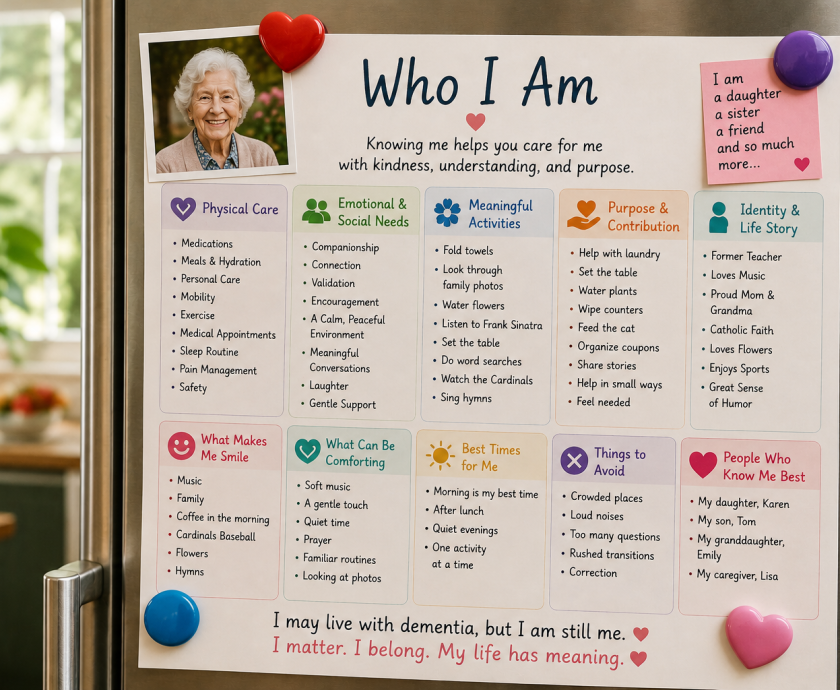
A toothbrush left visible on the bathroom counter may encourage independent brushing. A favorite sweater displayed where it can be easily seen may make getting dressed easier. A family photo on a bedroom door may help someone find their room. A calendar, whiteboard, or daily schedule can provide reassurance about what comes next.
One of the most powerful cues is routine. When activities happen at roughly the same time and in the same order each day, the brain begins to anticipate what comes next. Predictability reduces uncertainty, and uncertainty often creates anxiety.
The environment can also help invite participation. Instead of explaining every step of an activity, try setting it up first. Put the puzzle on the table. Lay out the cards. Set the table before a meal. Place baking ingredients on the counter. The environment itself becomes a cue.
The Best Cues Are Personal
Not every cue works for every person.
The most effective cues are often meaningful to the individual.
A favorite family photo.
A beloved chair.
A treasured quilt.
A favorite coffee mug.
A lifelong routine.
A familiar song.
The brain often responds more strongly to things that are emotionally meaningful than to generic signs or labels.
Person-centered cueing is often the most successful cueing.
Often the most effective cues are not the most elaborate. They are simply the easiest to see, recognize, and connect with emotionally.
Reducing Moments of Failure
Many people living with dementia experience repeated moments of failure throughout the day.
They may forget a step.
Lose an item.
Become confused.
Struggle to find the right word.
Or feel uncertain about what comes next.
Thoughtful cues help reduce those moments of failure and replace them with opportunities for success.
And success matters.
Success builds confidence.
Success reduces frustration.
Success supports dignity.
Putting It Into Practice: This Week’s Action Steps
Action Item #1: Become a Cue Detective
Choose one daily activity your loved one completes each day.
As you observe, ask yourself:
☐ Are the items needed for the activity visible?
☐ Are important items hidden in drawers, cabinets, or closets?
☐ Are there too many choices creating confusion?
☐ Could a visual cue help?
☐ Is the person being expected to remember a step that the environment could support?
☐ Is there a way to make success easier?
Goal: Begin looking for ways the environment can support success rather than relying on memory alone.
Action Item #2: Complete a Cue Walkthrough
Walk through your home from the perspective of your loved one.
Ask yourself:
☐ Can they easily identify the bathroom?
☐ Can they easily identify their bedroom?
☐ Are important items within their visual field?
☐ Are frequently used items easy to find?
☐ Are there family photos or familiar objects that help with orientation?
☐ Are daily routines supported by the environment?
☐ Are there opportunities to simplify or reduce confusion?
Write down three opportunities to improve cueing in your home.
Then choose one simple change to implement this week.
Examples:
☐ Add a bathroom sign.
☐ Place a family photo on a bedroom door.
☐ Move frequently used items into view.
☐ Create a simple daily schedule.
☐ Reduce unnecessary clutter.
☐ Set up an activity before inviting participation.
This Week’s Reminder
Stop testing. Start cueing.
Don’t test the memory. Support the success.
Because dementia care is not about proving what someone can no longer remember.
It is about creating an environment that helps them use the abilities they still have.
And sometimes the smallest cue can create the biggest success.
💜
Next Week in Calm On Purpose: We’ll explore how familiarity, routines, and emotional safety help create environments where people living with dementia feel calm, confident, and connected.