Category: Emotional & Spiritual Support

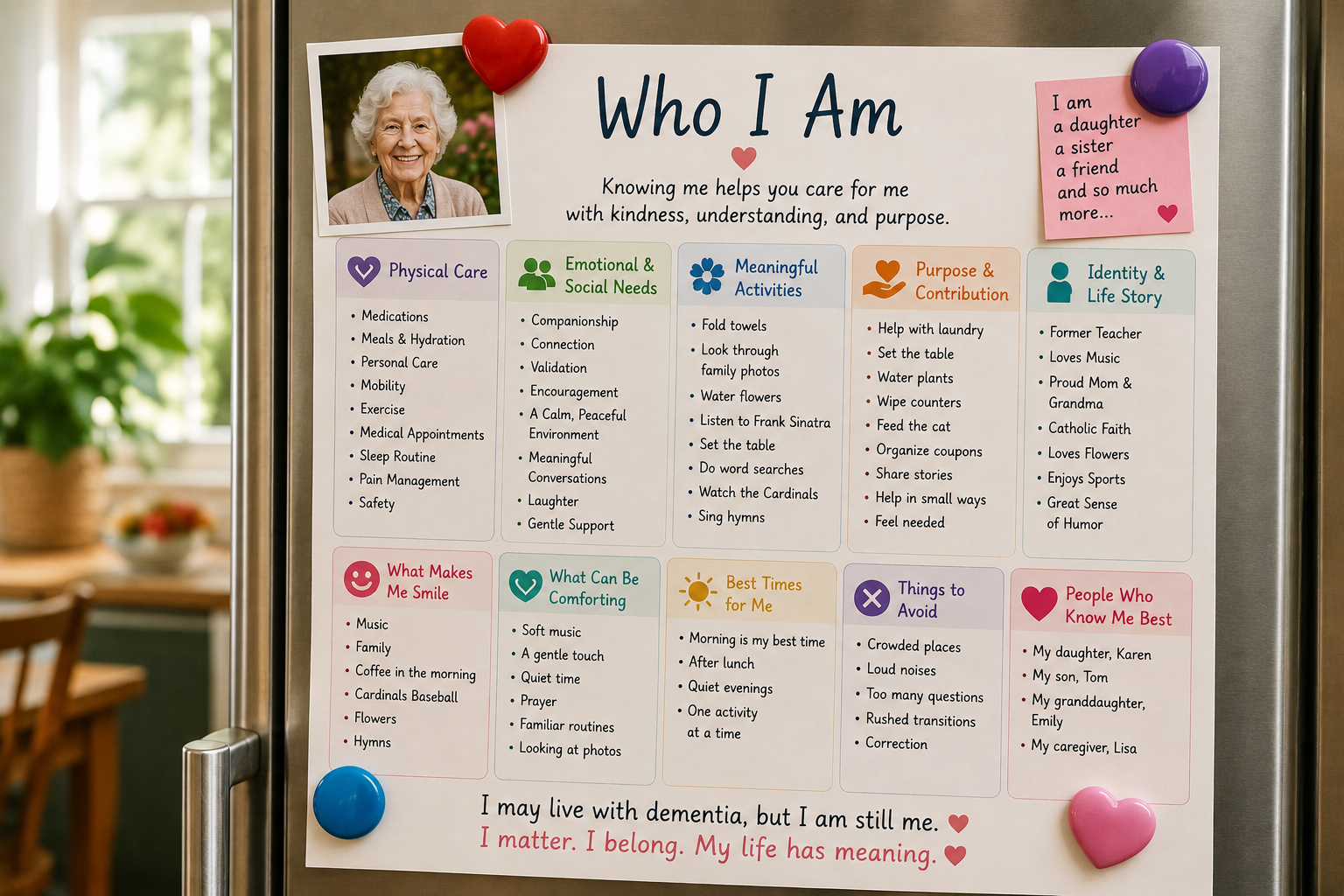
Who I Am
Daily Life & CaregivingEmotional & Spiritual SupportResources & Tools

Planting Purpose: Bringing Meaningful Engagement Into Everyday Life

Over the past several weeks in our May Flowers series, we have explored something we believe deeply at Dementia Life STL:

A meaningful life does not end with a dementia diagnosis.

We have talked about why activities are not simply “something to do.”
We have explored how meaningful engagement supports emotional well-being, reduces distress, and helps a person continue to feel connected to the world around them.

We have learned how to:

  • Adapt activities to match remaining abilities
  • Focus on strengths instead of losses
  • Create person-centered moments rooted in lifelong interests, routines, and identity
  • Preserve purpose, dignity, and joy at every stage of dementia

This week, we want to bring it all together.

Because eventually every family asks the same question:

“Okay… but how do we actually make this happen day to day?”

How do we move beyond good intentions and create a life that truly supports meaningful engagement on a regular basis?

At Dementia Life, our answer is simple:

Meaningful engagement should become part of the care plan – not an afterthought.

Because quality dementia care is about far more than medications, meals, and appointments.

It is about creating a life that still feels like life.


Every Person Living with Dementia Deserves More Than Physical Care Alone

When most people hear the words “care plan,” they think about:

  • medications
  • doctor appointments
  • bathing
  • safety concerns
  • mobility needs

And yes – those things matter tremendously.

But a person living with dementia is still a whole person.

Meeting physical needs keeps someone alive.

Meaningful engagement helps them live.

A truly supportive care plan should include both.


Meaningful Activities Belong in the Care Plan Too

Imagine a daily care plan that looks something like this:

8:00 AM – Breakfast
9:00 AM – Medications
10:00 AM – Fold towels while listening to Frank Sinatra
12:00 PM – Lunch
2:00 PM – Water flowers on the patio
4:00 PM – Look through family photo albums
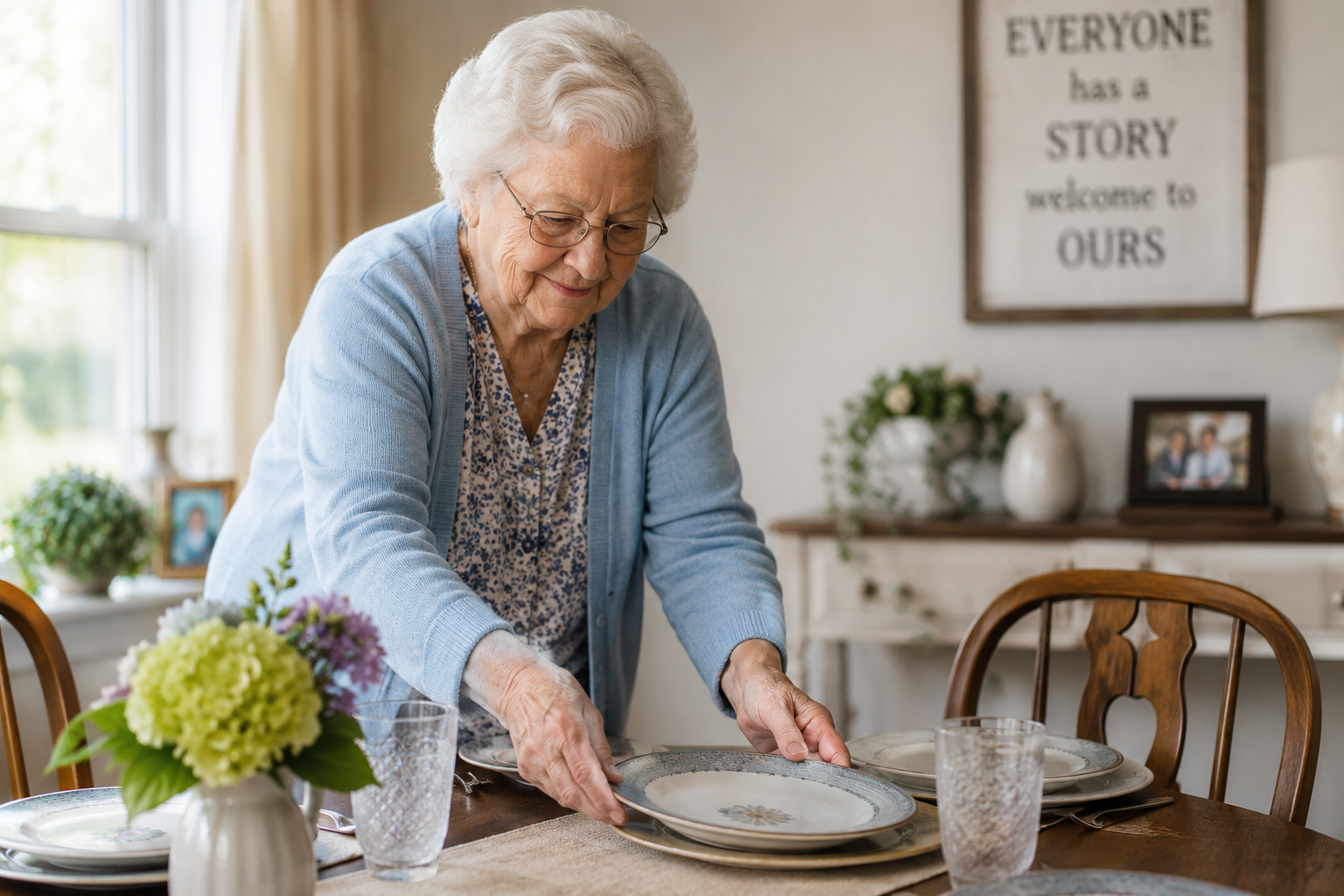
5:30 PM – Help set the table
7:00 PM – Evening prayer and favorite hymns

This is not “keeping someone busy.”

This is preserving identity.
This is reducing boredom and isolation.
This is helping a person remain connected to familiar rhythms and meaningful roles.

And a care plan that includes those things helps everyone who is involved in the individual’s care have the same goal in mind.


Start Small

You do not have to transform the entire day overnight.

In fact, adding just two intentional, person-centered moments into your loved one’s daily routine is an incredible place to begin.

Ask yourself:

What is one familiar daily task that could help my loved one feel purposeful and included?

And:

What is one hobby, leisure activity, or simple pleasure they would genuinely enjoy?

That’s it.

Maybe it is:

  • folding towels
  • watering flowers
  • helping stir cookie batter
  • setting the table
  • feeding the dog

And maybe their leisure activity is:

  • listening to favorite music
  • sitting outside
  • looking through photographs
  • watching birds
  • reading scripture
  • completing a word search
  • watching an old western

Those moments may seem simple.

But simple does not mean insignificant.


Putting the Thoughts To Paper

Once you begin identifying meaningful activities, familiar routines, and purposeful roles, the next step is straightforward:

Write it down.

It does not need to be fancy.
It does not need to look clinical or professional.

In fact, sometimes the best care plans are the simplest ones.

It might be:

  • a notebook on the kitchen counter
  • a piece of paper taped to the refrigerator
  • a dry erase board
  • a binder shared between family members
  • a simple printed daily routine

What matters most is not perfection – it is having a plan.

When meaningful engagement stays only in our heads, it is easy for it to get lost in the stress and busyness of caregiving.

But when it is written down, it becomes intentional.

A written plan also helps create consistency between caregivers. Spouses, adult children, home care staff, volunteers, respite caregivers, and memory care staff can all better understand what brings comfort, what creates joy, what gives the person purpose, what activities are calming, what routines are familiar, and what helps the day go more smoothly.

Even something as simple as:

“After breakfast, Mary enjoys watering flowers and listening to gospel music”

can help transform the tone of the entire day.


You Do Not Have to Do This Alone

Caregiving can feel incredibly isolating, especially when all responsibility seems to fall on one person.

Invite others in.

Grandchildren can read stories or do crafts.
Church members can visit and sing hymns.
Neighbors can stop by for coffee.
Friends can look through photo albums together.
Volunteers can lead music, games, or art activities.

Sometimes all it takes is one caring visitor, one shared laugh, one familiar song, or one meaningful conversation to brighten an entire day.


If Your Loved One Lives in Assisted Living or Memory Care

Many families worry:

“The staff is already so busy.”

And that concern is understandable.

But families still play an incredibly important role in helping staff understand the person behind the diagnosis.

We encourage families to share:

  • preferred name
  • former occupation
  • favorite music
  • hobbies and interests
  • comforting routines
  • spiritual practices
  • favorite topics
  • activities they dislike
  • best times of day for engagement

The more staff members know about the individual, the more opportunities there are for truly person-centered care.

Families can also help create additional opportunities for engagement by:

  • leading a small music group
  • organizing sing-alongs
  • helping with gardening
  • coordinating intergenerational visits
  • recruiting volunteers
  • donating activity supplies
  • bringing in musicians, students, or community groups

One meaningful activity can ripple outward and touch many residents – not just your loved one.


The Goal Is Not Just Survival – It Is Quality of Life

At Dementia Life, we believe dementia care should never focus solely on preventing decline.

It should also focus on preserving life, connection, identity, and joy.

A strong care plan should answer two equally important questions:

How will we help meet this person’s physical needs?

AND

How will we help this person continue to experience meaning, purpose, comfort, and connection?

Because even in the midst of dementia, meaningful moments are still possible.

And those moments matter.


Need Help Creating a Dementia Care Plan?

If your family would like support creating a personalized dementia care plan, we would be honored to walk alongside you.

Learn more at Dementia Life STL.

setting table
Daily Life & CaregivingEmotional & Spiritual SupportUncategorized

Making Engagement Truly Person Centered

In spring, flowers do not bloom because we tell them to. They bloom when they are given the right conditions: sunlight, nourishment, time, and care.

The same is true for people living with dementia.

Meaningful engagement does not happen simply because we place an activity in front of someone. True engagement happens when we understand who that person is, who they have always been, and what continues to give their life meaning and purpose.

I believe that every person living with dementia remains a whole person with a rich history, enduring preferences, and a deep need for purpose. Dementia changes the brain, but it does not erase identity.

When we make engagement person-centered, we are no longer asking:

“How can we get this person to comply?”

Instead, we ask:

“Who is this person, and what would bring meaning to this moment?”


Why Person-Centered Engagement Matters

Person-centered engagement is rooted in one simple but powerful principle:

People living with dementia are more likely to feel calm, connected, and fulfilled when they are engaged in activities that reflect their identity and life story.

In many cases, behaviors we view as “challenging” are actually attempts to communicate an unmet need.

Often, that unmet need is purpose.


The Deep Human Need for Purpose

Many people living with dementia feel an internal sense that they are supposed to be doing something important.

They may pace.
They may repeatedly ask to “go home.”
They may say they need to “get to work.”
They may become restless or anxious.

These are not random behaviors.

They are often expressions of an inner awareness – what I often call the person’s internal “knower.”

A retired teacher may feel she should be helping others learn.
A father may feel responsible for protecting his family.
A homemaker may feel compelled to keep things orderly.
A mechanic may feel he should be fixing something and using his hands.
A nurse may feel the need to care for others.

The individual may no longer be able to explain what they are feeling, but deep inside, they know they are meant to contribute.

When we provide meaningful roles, we honor this need and help restore a sense of belonging, dignity, and purpose.


Understanding the Whole Person

To create truly person-centered engagement, we must become curious about the person’s life story.

Important areas to explore include:

Past Roles and Identity

How did they see themselves?

  • Mother or father
  • Teacher
  • Farmer
  • Veteran
  • Caregiver
  • Community leader
Hobbies and Interests

What brought them joy?

  • Gardening
  • Fishing
  • Sewing
  • Music
  • Sports
  • Cooking
  • Reading
Culture and Traditions

What customs shaped their life?

  • Holiday celebrations
  • Family recipes
  • Language
  • Ethnic traditions
  • Community gatherings
Spiritual Beliefs

What gave them comfort and meaning?

  • Prayer
  • Worship services
  • Sacred music
  • Scripture readings
Work History

What skills and routines defined their professional life?

  • Managing schedules
  • Repairing equipment
  • Teaching others
  • Organizing paperwork
Daily Routines

What was their usual rhythm?

  • Early riser or night owl
  • Day shift or evening shift
  • Re-entering the home after a day’s (or night’s) work
Personality

Were they:

  • Outgoing or private?
  • Structured or spontaneous?
  • Humorous or serious?
  • Independent or collaborative?
Preferences

What did they consistently enjoy—or avoid?

Sensory Likes and Dislikes

What sensory experiences brought comfort, and which ones caused distress?

Current Abilities

What can they still do successfully with or without support?

Best Time of Day

When are they most alert, calm, and engaged?


Creating Meaningful Roles

One of the most powerful ways to support someone living with dementia is to give them a purposeful role.

This role should feel familiar and meaningful – not artificial or childish.

Meaningful roles draw from the person’s lifelong responsibilities, routines, and strengths.

Examples of Meaningful Roles at Home
  • Folding laundry
  • Sorting mail
  • Watering plants
  • Setting the table
  • Matching socks
  • Organizing photos
  • Stirring ingredients
Examples in Assisted Living or Memory Care
  • Welcoming other residents
  • Delivering napkins
  • Helping arrange flowers
  • Organizing activity supplies
  • Reading aloud
  • Leading songs or prayers

These tasks may seem simple, but to the individual they can represent something profoundly important:

“I still matter.”
“I still contribute.”
“I still have a purpose.”


Real-Life Examples

The Homemaker

A woman who spent decades caring for her family became anxious each afternoon. When staff invited her to fold towels and organize linens, she became noticeably calmer.

The Teacher

A retired educator often corrected others and became frustrated. Giving her books to look through and papers to organize allowed her to reconnect with her lifelong identity.

The Farmer

A lifelong farmer paced and asked to go outside. Providing seed catalogs, potted plants to water, and opportunities to spend time outdoors significantly reduced his restlessness.

The Nurse

A former nurse frequently followed other residents in an effort to help them. Instead of discouraging this, staff invited her to assist with comfort rounds and hand out blankets.


Matching Engagement to Current Abilities

Person-centered engagement is not about asking someone to do what they used to do exactly as before.

It is about adapting activities to match what they can do today.

The goal is the experience, not perfection.

A former accountant may no longer balance books but may enjoy sorting papers.
A gardener may no longer manage a large yard but can water a few plants.
A cook may no longer prepare meals independently but can stir batter or arrange ingredients.

Abilities remain throughout every stage of dementia. Our role is to identify those remaining abilities and create opportunities for meaningful participation.


Practical Questions to Ask

When planning engagement, consider:

  • Who has this person always been?
  • What responsibilities gave them meaning?
  • What skills remain intact?
  • What brings comfort and joy?
  • What time of day are they most successful?
  • What role can they still fulfill today with adaptation and support?

A Garden Still in Bloom

Dementia changes many things, but it does not eliminate the human need to feel useful, connected, and valued.

When we learn a person’s story and create opportunities that reflect their identity, we help them continue to bloom – to remain an active part of their world rather than merely existing in ours.

A folded towel.
A watered plant.
A set table.

These moments may appear ordinary, but they carry extraordinary meaning.

Because beneath the cognitive changes, the person is still there.

Still capable of contributing.
Still longing for purpose.
Still deserving of dignity.
Still blooming.

Female Doctor Talking with Senior Adult Woman About Hand Therapy.
Daily Life & CaregivingEmotional & Spiritual SupportPersonal Stories & TestimoniesResources & Tools

Learning To Dance: A Nurse’s Journey Into Dementia Care

THE NURSE WHO COULD TALK TO ANYONE 

I’ve always seen myself as someone who connects easily with others. Striking up conversations with strangers, finding common ground with people from all walks of life — it came naturally to me. I prided myself on being nonjudgmental and making others feel at ease, no matter their background or story.  

It’s one of the reasons I felt so drawn to nursing. That ability to build quick trust became one of my greatest strengths as a Registered Nurse. 

WHEN CONFIDENCE TURNS TO UNCERTAINTY 

But when I started working with patients with dementia, something shifted.  

For the first time in my career – maybe in my life – that ease didn’t come so naturally. The connection I had always relied on felt just out of reach. And that was a humbling experience. 

I expected my personality, my training, and my nursing background to be enough. Afterall, I had studied the symptoms. I understood the disease process. I had practiced communication strategies and memorized the medications and treatments used for common behaviors. I was prepared… or so I thought.  

But nothing quite prepared me for the real thing. 

I became rigid. Uncomfortable. Unsure of myself and my actions. I had been taught to speak to and treat my elders in a certain way, and suddenly, none of it seemed to apply. I was in a world of unknowns — and frankly, it baffled me. 

TRAINING ISN’T THE SAME AS EXPERIENCE 

The truth is, no amount of training can fully ready you for the emotional, unpredictable, often tender moments that come with caring for someone with dementia.  

And that’s okay. 

It’s okay if you feel uncomfortable at first. I did, too

I remember second-guessing my words, wondering if I was doing the right thing, feeling overwhelmed when a patient grew agitated or confused. I wanted to fix it. I wanted to connect. And sometimes —despite my best efforts — I felt like I was falling short. 

But what I’ve come to realize over time is this: Caring for someone with dementia is not about perfection. It’s about presence. 

THE MOMENT IT CLICKED 

I remember the exact moment it finally clicked — the moment I truly understood what it takes to work with someone living with dementia.  

I was caring for a patient in a dementia unit at a long-term care facility. She sat in her wheelchair, parked in the hallway, firmly refusing to return to her apartment. After trying every gentle nudge I could think of, I gave in and began changing her wound dressing right there in the hallway. 

As I worked, I heard footsteps approaching from around the corner. A Physical Therapist appeared, guiding another dementia patient beside him. He was trying to teach her how to use her walker safely, but she was growing more frustrated and agitated by the second. 

I paused, curious to see how he would respond. 

Then, something beautiful happened.  

He stopped. He turned to face her, looked into her eyes with calm assurance, and gently took the walker from her hands, setting it aside. 

Then, with a warm smile, he extended his hand and asked: 

“May I have this dance?” 

She giggled — an honest, childlike laugh — and placed her hand in his. And just like that, they began ballroom dancing down the hallway. Not walking. Not redirecting. Dancing. 

They floated down the corridor as staff, visitors, residents, and even physicians watched with wide smiles. Laughter filled the space as they moved together—completely immersed in the moment. 

And that’s when it hit me. 

WHAT I KNOW NOW 

There is no one-size-fits-all approach. What worked for one person on Monday may not work for another on Tuesday. And that’s okay.  

It’s okay to learn as you go. It’s okay to take a breath, to pause, to regroup. It’s okay to make mistakes — and it’s more than okay to forgive yourself for them. 

Because what matters most is that you show up. And that you keep showing up. That you offer kindness, patience, and grace — not just to the person you’re caring for, but to yourself as well. 

CONNECTION BEYOND WORDS 

Working with dementia patients has taught me that connection doesn’t always come from words. Sometimes it’s found in quiet companionship, a gentle touch, or a shared moment of laughter. Sometimes, simply being there — calm, steady, and compassionate — is enough. 

So if you’re new to this, if you’re struggling, if you’re wondering whether you’re doing it “right,” I want you to hear this clearly:  

You are not alone. 

It’s okay to ease into it. It’s okay if it doesn’t come naturally. And it’s absolutely okay to grow into the role over time. 

THE LONG AND WINDING ROAD 

Dementia care is a journey — one of empathy, adaptation, and continuous learning. And if your heart is in the right place, you’re already doing better than you think. 

-Brooke Glenn RN 

hands
Emotional & Spiritual SupportFamily SupportPersonal Stories & TestimoniesUnderstanding Dementia

The Power of Yes: How I Learned to Step Into My Mom’s World

Who knew the 2016 Summer Olympics could help me figure out how to communicate with my mother.

I’ll get to that, but first, a little background.


My mother and I have never seen eye-to-eye and were great with arguments and eye rolls. When she was diagnosed with Alzheimer’s Disease around 2009, it got even harder. If you are reading this, I know you get it. Getting the same questions over and over again is exhausting, annoying, and infuriating. If you haven’t figured it out yet, the absolute worst thing you can do is say, “Mom, I just told you that three times in the last hour.”

Yep, trust me—it won’t work.

If your father (her husband) is an uber-high Type A and was in management his entire life, not having her remember or do what he said is also unpleasant.

My mother’s name was Fran. She stood 4’10½” at her tallest and weighed in at a solid 95 pounds for most of her life. She was a bundle of energy. She taught high school, and big football players cowed to her. Needless to say, she could hold her own and send you running with “that look.” She always said ‘dynamite comes in small packages,’ and Little Frannie proved that.

Fast forward to 2016.

She was hospitalized for something, probably an extreme UTI. While she was in the hospital, she was asking me about her friend Eustacius and whether she had decided to buy the house. I thought to myself, ‘who the heck is Eustacius, and what house are you talking about?’
I just kind of said I hadn’t talked to her and we moved on.
That was my first experience with Hospital-Induced Delirium. The National Institutes of Health defines it as “a temporary but severe form of mental impairment that can lead to longer hospital stays and negative long-term outcomes, commonly acquired by elderly patients in acute care settings. Up to a third of patients 70 years old and above experience delirium, and the rate is much higher for those in intensive care or undergoing surgery. Until recent decades, hospital-acquired delirium, which typically lasts anywhere from a couple of days to several weeks but can even last months, was chalked up to old age and not considered a condition to be prevented or treated.”
In layman’s terms, I would say it is like the “crazy” that comes with a UTI but multiplied maybe tenfold. In my experience, it cleared up the minute we got her out of the hospital environment.

Now, as to how the Olympics helped.

There was some controversy going on with the U.S. Swimming Team at the Rio Summer Olympics. Mother was in a rehab facility after the above-mentioned hospitalization and had a roommate who listened to the Olympics all day and night. This ended up burrowing into Mother’s head, and she felt certain the police were coming to arrest her because of some party and the damage that was done. She wanted to know
what my husband thought. I told her he knew nothing about it. I told her it was no big deal and I hadn’t seen any police around, so I was sure she didn’t need to worry.
After about three days, I finally walked out of the room for a little while and went back in and told her I checked with the nurses. They told me the police said they arrested the culprits and didn’t need to talk to her.

That was that. She was satisfied with that answer.

That was the moment when I realized that you need to get into the world of someone with dementia.

We feel so bad “lying” to our parents and loved ones, but we call it “situational fibbing” and, in my opinion, it is 100% acceptable.  Think about it this way-Your loved one wants to go see their parents, who have been dead 20 years.  What do you say?  I always said they were on vacation for a couple of weeks.  Why would you tell them they are dead and keep getting them upset every 15 minutes?   I found out after she passed, when I started volunteering for the Alzheimer’s Association, that this is a key tip. Their reality IS reality. Meet them there. Have fun. I think of it like improv. Just go with what they are experiencing. I found through this that humor was a great way for us to connect. When she had a hard time saying a word, I would just say, “Well, that was easy for YOU to say,” and laugh. She would laugh and say, “Nope, not really.”

What I learned:
* You cannot control the situation.
* Get into their reality.
* Find some “canned” answers for those repetitive questions and use them until they don’t work anymore (a dementia patient will not remember you already told them.)
* Find a communication style that works for you and your loved one. Ours was humor.
* Find resources. There are so many good resources to use. Do not be afraid to ask for help.
* Take care of yourself. It’s like on a plane—put on your oxygen before you help someone else.

As frustrated as you get (you will and it is OK—it is a real emotion), remember that it is ultimately an honor to care for them and these are days and memories you will cherish.

view of two persons hands
Emotional & Spiritual SupportFamily Support

The Silent Struggle: Caregivers of Loved Ones with Dementia

Caring for a loved one with dementia is one of the most demanding, emotionally taxing, and often isolating experiences a person can face. As counselors, we are uniquely positioned to support these unsung heroes—those who carry the weight of compassion fatigue, role reversal, and chronic grief with quiet resilience.

The Emotional Landscape of Dementia Caregiving

Caregivers of individuals with dementia often describe the experience as a “long goodbye.” Unlike other forms of loss, dementia progresses gradually, stealing pieces of a person’s identity over time. This slow erosion brings with it profound emotional distress:

  • Ambiguous loss, where the person is physically present but psychologically absent
  • Chronic sorrow, a persistent grief that resurfaces at every stage of decline
  • Burnout and compassion fatigue, from the relentless nature of daily care

As therapists, it’s critical to acknowledge and validate these experiences. Caregivers often carry guilt for feeling frustrated or depleted—emotions that are normal and deserve compassionate exploration.

Therapeutic Goals for Dementia Caregivers

Effective counseling for these clients involves both emotional processing and practical empowerment. Key goals include:

  • Naming the grief – Helping caregivers understand that their emotional response is not only valid but expected
  • Boundary setting – Encouraging sustainable caregiving through shared responsibilities and outside support
  • Identity preservation – Supporting caregivers in maintaining their sense of self outside of the caregiving role
  • Psychoeducation – Providing information about dementia’s progression and behavioral changes to reduce anxiety and foster preparedness
  • Mindfulness and regulation tools – Teaching caregivers to manage the stress of repetitive questions, aggression, or wandering with grounded emotional presence

Integrating Tools for Support

Many caregivers benefit from integrative strategies such as:
Narrative discussions that help to reframe their story from burdened to brave

Group therapy or support groups, which offer connection and a reminder: “You are not alone”
Creative interventions, including music and art, which can be shared with the loved one and serve as meaningful forms of connection.

The Caregiver’s Care Plan

Often, our most important role is helping caregivers create a self-care strategy that feels doable. That might include respite care referrals, gentle encouragement to reengage in activities they once enjoyed, or simply a safe space to cry and say, “This is hard.” Caregiving doesn’t come with a manual—but it does call for deep courage. And sometimes, that courage starts in the counseling room, or a hospital room or in a living room, with a single moment of being seen and heard.