July Blog Week 4
Uncategorized

Dementia Detective Dining: Looking for Clues

One of the hardest parts of caring for someone living with dementia is that their actions don’t always make sense. Why won’t they eat? Why are they refusing to shower? Why do they suddenly become upset? Why do they keep asking the same question?

As caregivers, our first instinct is often to stop the behavior or solve the problem as quickly as possible. At Dementia Life, we encourage a different approach.

We encourage you to become a Dementia Detective.

Instead of asking, “How do I stop this behavior?” ask yourself, “What is this behavior – and this person – trying to tell me?”

Behavior is communication. Every behavior has a reason, even if the reason isn’t immediately obvious. Our job isn’t to control the behavior – it’s to look for the clues.

No matter what challenge you’re facing, we begin by asking the same four questions.


🕵️ STOP: LOOK FOR CLUES

When something isn’t going as planned, pause before reacting and ask yourself:

🩺 Physical
How does their body feel?

🏡 Environment
What around them is helping or hurting?

❤️ Emotional
How are they feeling?

🤝 Caregiver Approach
How am I influencing this moment?

These four clues can help us understand many of the challenges that come with dementia – not just eating and drinking, but bathing, dressing, communication, activities, sleep, and so much more.

Understanding the Four Clues
🩺 Physical

The first place to investigate is the person’s body. Pain, constipation, hunger, thirst, fatigue, medication side effects, illness, dental problems, difficulty swallowing, or simply needing the restroom can all affect behavior. Because dementia makes it harder to recognize, remember, or communicate these needs, a person may not be able to tell us what’s wrong. Looking for physical causes first often uncovers simple problems with simple solutions.

🏡 Environment

Next, look at what is happening around the person. The environment can either support success or create barriers. Noise, lighting, room temperature, strong smells, visual clutter, poor contrast, or even a task that no longer matches the person’s abilities can make everyday activities much harder than we realize. Sometimes the easiest solution isn’t changing the person—it’s changing the environment.

❤️ Emotional

People living with dementia continue to experience a full range of emotions, even when they can no longer express them with words. Anxiety, sadness, boredom, loneliness, embarrassment, frustration, or feeling overwhelmed can all influence behavior. When we recognize those emotions, we can respond with reassurance instead of correction.

🤝 Caregiver Approach

Finally, take a moment to consider yourself. Our tone of voice, body language, facial expressions, pace, and emotional energy all influence the person in front of us. The way we communicate can either increase stress or help someone feel safe and successful. Visual cues, verbal cues, and gentle touch cues are all powerful tools that help guide rather than correct. Often, changing our approach changes the outcome.

Special Note: 🩺 When Should You Call the Doctor?

Not every change in eating or drinking is simply part of dementia. Sometimes it can be a sign that something else is going on.

Reach out to the person’s healthcare provider if you notice:

  • A sudden or significant change in appetite or fluid intake.
  • New or worsening difficulty chewing or swallowing, including frequent coughing or choking while eating or drinking.
  • Signs of dehydration, such as very dark urine, dizziness, extreme fatigue, dry mouth, or confusion that is worse than usual.
  • Ongoing vomiting, diarrhea, or an inability to keep fluids down.
  • Noticeable weight loss or clothing that is becoming much looser.
  • Persistent mouth pain, tooth pain, or sores that may make eating uncomfortable.
  • A sudden increase in confusion, unusual sleepiness, fever, or a significant change from their typical behavior.

Difficulty swallowing (dysphagia) is not considered a normal part of aging or dementia and should always be evaluated by a healthcare professional. Early evaluation can help reduce the risk of choking, aspiration, dehydration, and malnutrition.

Behavior is communication – but sometimes it is also the body’s way of telling us that medical attention is needed. Trust your instincts. You know your loved one best, and if something feels different or concerning, it’s always appropriate to reach out to their healthcare provider.

Let’s Apply the Detective Framework to Eating & Hydration

Eating is something most of us enjoy without giving it much thought. For someone living with dementia, however, mealtimes can become surprisingly complicated. The brain has to recognize hunger or thirst, identify the food, remember how to use utensils, coordinate the physical movements of eating, and filter out distractions in the environment. What once happened automatically may now require tremendous effort.

When eating or drinking becomes difficult, it is tempting to focus only on the food. But as Dementia Detectives, we know to look deeper.

If someone suddenly stops eating, ask yourself whether they could be uncomfortable or in pain. Could constipation, dry mouth, medication side effects, or needing the restroom be affecting their appetite?

Next, look at the environment. Is the television on? Is the room noisy? Can they clearly see the food on the plate or the water in the glass? Would a brightly colored plate, cup, or placemat provide better visual contrast? Are the utensils easy for them to manage?

Then consider their emotions. Are they feeling anxious, rushed, overwhelmed, or discouraged because eating has become more difficult? Would slowing down, sitting together, or trying again later create a more positive experience?

Finally, reflect on your own approach. Are you asking repeated questions or correcting them? Or are you offering calm guidance, modeling the first bite, using simple verbal cues, and celebrating each success instead of focusing on what wasn’t accomplished?

Putting It All Together

Imagine your mom suddenly refuses lunch.

At first, you might think she’s simply being stubborn.

But then you remember to STOP: LOOK FOR CLUES.

You realize she hasn’t used the restroom in several hours, so you help her to the bathroom before lunch. You notice the television is blaring in the background and her white plate blends into the light-colored table, so you turn off the TV and serve her meal on a bright blue plate. She still seems a little anxious, so instead of encouraging her to “finish her lunch,” you sit beside her and begin talking about one of her favorite family vacations. Then, rather than saying, “Mom, you need to eat,” you simply smile, pick up your own sandwich, and say, “This looks good. Let’s have lunch together.”

A few minutes later, she quietly takes her first bite.

What changed?

Not your mom.

You changed the conditions around her. You removed barriers, reduced stress, and adapted your approach to set her up for success.

That’s what Dementia Detectives do.

💙 Remember This

Behavior is communication.

The next time something doesn’t make sense, resist the urge to ask, “How do I stop this behavior?”

Instead…

🕵️ STOP: LOOK FOR CLUES.

When we understand the reason behind the behavior, we can respond with compassion instead of frustration. And that’s where the very best dementia care begins.


July Blog Week 3
Daily Life & Caregiving

Hydration Matters: 5 Simple Ways To Help Someone With Dementia Stay Hydrated

Sarah couldn’t understand why her dad kept saying he wasn’t thirsty.

His water glass sat untouched beside his favorite chair. Every hour she reminded him to take a drink.

“Dad, you need more water.”

“I’m fine,” he’d reply.

By the end of the day, he seemed more confused than usual, was unsteady on his feet, and became frustrated over little things. Sarah wondered if his dementia was getting worse.

It wasn’t until his nurse gently asked, “How much has he had to drink today?” that she realized the problem may not have been dementia at all – it may have been dehydration.

For someone living with dementia, staying hydrated isn’t always as simple as picking up a glass of water. Dementia changes the brain, and a person may:

  • Not recognize that they are thirsty.
  • Not remember it’s time to drink.
  • Not know how to complete all the steps involved, like finding a cup, filling it, and taking a drink (called sequencing).
  • Avoid drinking because they’re worried about needing the bathroom more often.

The good news? A few simple changes can make hydration much easier.

1. Make Hydration Easy to See

If a favorite cup is tucked away in the kitchen cupboard, it may be forgotten.

Keep a favorite cup or water bottle visible and within easy reach. Brightly colored cups often make drinks easier to notice.

Visual reminders can also help. A simple sign placed near the person’s favorite chair, on the refrigerator, or by the coffee maker that says “Please Drink Water”, “It’s Time for a Drink”, or “Take a Sip” can serve as a gentle cue. Be sure the sign uses large, easy-to-read lettering with good contrast so it is easy to see.

Sometimes success isn’t about reminding the person more often – it’s about making the reminder part of the environment.

2. Guide Instead of Asking

Instead of asking,

“Would you like something to drink?”

Try saying:

  • “Let’s have something to drink together.”
  • “I brought you some lemonade.”
  • “It’s time for our afternoon tea.”

Questions require the brain to make a decision. Gentle guidance makes the next step easier.

Better yet, sit down and take a sip yourself – or raise your glass in a “toast.” People naturally imitate those around them, and drinking together often feels more like sharing a moment than receiving a reminder.

3. Build Hydration Into the Day

Instead of relying on memory, connect drinks to routines that already happen.

Offer fluids:

  • Upon waking up
  • After brushing teeth
  • With medications (when appropriate)
  • During a favorite television show
  • Before or after a walk
  • With every meal and snack

Routine reduces the need to remember.

4. Think Beyond Water

Water isn’t the only way to stay hydrated.

Water-rich foods like watermelon, strawberries, oranges, cucumbers, tomatoes, yogurt, smoothies, broth-based soups, applesauce, and homemade popsicles all help keep the body hydrated.

Some families also find success with products like Jelly Drops®, hydration gummies, added flavors, or low-sugar electrolyte beverages.

Every sip—and every bite—counts.

5. Don’t Turn It Into a Battle

If they refuse a drink, don’t argue.

Offer a small amount.

Try again later.

Sometimes a different cup, a quieter environment, or simply another time of day makes all the difference.

Our goal isn’t to win the moment.

It’s to create many opportunities for success.

Every Sip Counts

Hydration is about much more than water. It’s about helping someone feel their best, reducing discomfort, and supporting their overall health.

At Dementia Life, we believe the answer is rarely asking the person living with dementia to adapt to us. Instead, we adapt the environment and our approach so they have the greatest opportunity to succeed.

Offer without pressure.

Encourage without arguing.

Try again later.

Because every sip counts.

july Blog Week 2
Daily Life & Caregiving

Four Simple Ways To Create Mealtime Success

Last week, we explored why eating becomes more difficult as dementia changes the brain and how important it is to know your person. Every individual brings a lifetime of routines, preferences, traditions, and experiences to the table, and those don’t simply disappear because of a dementia diagnosis.

If you missed last week’s blog, you can read it here: https://dementialife.care/when-mealtimes-become-difficult/

As a quick reminder, think about what has always been true for the person you’re caring for:

  • What time of day have they always enjoyed eating?
  • What are their favorite comfort foods?
  • Are there foods they’ve never cared for?
  • Did they always say grace before meals?
  • Did they enjoy conversation around the table or prefer a quieter setting?

Those familiar routines and preferences often become the foundation for more successful mealtimes.

Now comes the question every caregiver asks:

The good news is that there are many small changes that can make a meaningful difference. No single strategy works for everyone, but when we slow down and adapt our approach to the individual, mealtimes often become calmer, more enjoyable, and more successful for everyone.

“What can I do?”

Here are four simple ways to help set the table for success.


1. Prepare for Success

Before we ever place food on the table, we’re already setting the stage for success – or frustration.

Preparation isn’t just about making the meal. It’s about preparing the person, the environment, and even ourselves.

Here are a few simple ways to help create a calm, successful mealtime:

  • Serve meals at consistent times whenever possible.
  • Turn off the television and reduce unnecessary background noise.
  • Limit distractions and keep only the items needed for the meal on the table.
  • Make sure glasses, hearing aids, or dentures are in place if they are normally used.
  • Consider whether your loved one may be tired, uncomfortable, experiencing pain, or need to use the restroom before sitting down to eat.
  • Take a moment to check in with yourself. If we’re rushed, anxious, or distracted, the person living with dementia often senses it.

A calm environment and a calm caregiver often lead to a calmer mealtime.


2. Extend an Invitation

How we invite someone to the table matters more than we often realize.

Instead of asking:

“Are you ready to eat?”

Try extending a warm invitation:

  • “Let’s have lunch together.”
  • “I made one of your favorites today.”
  • “Come sit with me.”
  • “It smells so good in here.”
  • “I’d love your company.”

Appeal to the senses. Mention the smell of fresh bread, warm soup, or homemade cookies. Create something inviting rather than something that feels like a task.

As you approach your loved one:

  • Approach from the front.
  • Smile and use their name.
  • Make gentle eye contact.
  • Offer one simple direction at a time.
  • If they tell you they’ve already eaten, avoid correcting or arguing. Simply redirect with kindness and extend another invitation.

The goal isn’t simply to get someone to eat.

The goal is to help them feel comfortable enough to come to the table.


3. Serve for Success

As dementia changes the brain, eating may become physically more difficult – even when a person is hungry.

Sometimes success has less to do with what we serve and more to do with how we serve it.

Think about removing unnecessary obstacles before the meal begins.

  • Offer familiar, favorite foods whenever possible.
  • Remove chicken from the bone before serving.
  • Cut foods into manageable bites when appropriate.
  • Peel fruit or prepare foods that may be difficult to manage independently.
  • Open condiment packets, milk cartons, straws, or wrappers ahead of time.
  • Serve one or two foods at a time if a full plate feels overwhelming.
  • Use lightweight cups that are easy to hold.
  • Choose utensils that fit comfortably in the person’s hand or adaptive utensils if they provide greater independence.
  • Consider plates with a taller rim to make scooping food easier.
  • Offer finger foods when utensils become frustrating or difficult to use.

Simple shifts can help preserve confidence, dignity, and independence.


4. Guide Through the Meal

Sometimes caregivers assume the person knows what to do once the meal is in front of them.

Because dementia affects sequencing and processing, they may need a little extra support.

The key is to begin with the least amount of assistance needed and only provide more if necessary.

Verbal Cues

Keep directions simple.

  • “Pick up your fork.”
  • “Take a bite.”
  • “Now let’s have a drink.”

Give one instruction.

Pause.

Allow time for the brain to process before speaking again.

Visual Cues

Sometimes showing works better than telling.

  • Point to the utensil.
  • Demonstrate taking a bite.
  • Take a sip from your own cup.
  • Model the next step.
Gentle Touch

When additional support is needed, gentle touch can provide reassurance.

  • A light touch to the elbow or hand.
  • Hand-under-hand guidance.
  • Guide – never force.

By beginning with the least amount of assistance and adding support only as needed, we preserve dignity while encouraging independence for as long as possible.


🍽️ This Week at the Table

Choose one or two of these strategies to try during a meal this week.

☐ Turn off the television before the meal begins.

☐ Invite your loved one by saying, “Let’s have lunch together,” instead of asking if they’re hungry.

☐ Remove one obstacle before serving the meal – take the chicken off the bone, unwrap the straw, open the butter packet, or serve one food at a time.

☐ After giving a simple direction, pause for five seconds before offering another cue. Those extra moments often give the brain the time it needs to respond.

Remember…

Small changes often create meaningful successes. One calm meal, one thoughtful adjustment, and one shared moment at a time.

July Blog Week 1
Daily Life & Caregiving

When Mealtimes Become Difficult

If you’ve ever found yourself saying…

“She won’t eat anymore.”

“He says he’s not hungry.”

“She only wants sweets.”

“He loved this meal last week!”

…you’re not alone.

Mealtime changes are one of the most common challenges families face when caring for someone living with dementia. They can also be some of the most emotional. When a loved one refuses food or no longer seems interested in drinking water, we become very worried – and understandably so.

The good news is this:

There are many, many things we can try when eating and drinking become a challenge. And the more we understand why eating becomes difficult, the better equipped we are to respond with patience, creativity, and compassion.

Why Eating Becomes More Difficult

Most people think of dementia as a disease of memory, but it affects so much more than remembering names or appointments.

The brain is responsible for recognizing hunger, identifying food, concentrating on a meal, coordinating movements, processing sights and sounds, and understanding what is happening around us.

As dementia changes the brain, eating naturally becomes more challenging.

A person may have difficulty:

  • Recognizing that they’re hungry or thirsty.
  • Remembering they’ve already eaten – or that it’s time to eat.
  • Recognizing foods that suddenly seem unfamiliar.
  • Staying focused long enough to finish a meal.
  • Using utensils that once felt automatic.
  • Processing several foods or choices at the same time.

These are changes in the brain – not choices the person is making.

What’s “Normal?”

We all start to worry when we see the person having new changes or new struggles. And we often wonder, “Is this normal?” Every person living with dementia is different, but families often notice changes like these:

  • Eating more slowly.
  • Leaving meals unfinished.
  • Becoming distracted while eating.
  • Wanting the same foods repeatedly.
  • Preferring sweeter foods.
  • Forgetting how to use utensils or using them differently.
  • Saying they’ve already eaten.
  • Needing gentle encouragement to continue.

Perhaps the most important thing to remember is that dementia isn’t always consistent.

One day your loved one may enjoy a full meal. The next day they may barely touch it.

That doesn’t necessarily mean something is wrong – it often reflects the day-to-day changes that come with dementia.

Refusal Isn’t Always About the Food

When someone says, “I’m not hungry,” or pushes their plate away, we naturally take those words at face value.

But dementia teaches us to become detectives – and to see behavior as communication.

Sometimes “I don’t want it” really means:

  • “I’m overwhelmed.”
  • “I’m too tired.”
  • “I don’t recognize this.”
  • “I’m in pain or discomfort.”
  • “There’s too much happening around me.”
  • “I’m anxious.”
  • “Something doesn’t feel right, but I can’t explain it.”

The words may stay the same, but the meaning behind them can be very different.

When we pause to wonder what the person might be experiencing instead of simply reacting to what they say, we open the door to more compassionate, person-centered care. And we open the door to discovering possible solutions.

The Best Place to Start: Know Your Person

If there’s one thing we hope you take away from this week’s blog, it’s this:

Successful meals begin with knowing the individual.

There are countless ideas for helping someone living with dementia eat and drink more successfully. Throughout this month, we’ll share many of them. But every one of those strategies works best when it’s built on a deep understanding of the individual.

Person-centered care begins long before the meal is served.

Think about the people you love. Chances are, you know exactly how they take their coffee, which restaurant they’ll choose every time, what foods they avoid, and which dessert they never pass up.

We’re no different.

Food is deeply personal.

It reflects our culture, our traditions, our comfort, our routines, and even our personalities.

Some people have always preferred a light breakfast. Others aren’t hungry until mid-morning. Some enjoy three meals a day, while others have always grazed throughout the day. One person may reach for iced tea at every meal, while another wouldn’t dream of eating without a glass of milk.

Now imagine having all of those preferences…but struggling to communicate them.

Imagine being served foods you don’t enjoy, at a time of day you’ve never liked to eat, in a room that’s noisy and overwhelming – and not having the words to explain why it doesn’t feel right.

Dementia doesn’t erase a lifetime of habits and preferences. In fact, familiar foods, routines, and traditions often become even more meaningful as the disease progresses.

The better we know the person, the better we can create mealtime experiences that feel familiar, comforting, and successful.

Everything else we’ll discuss this month – creating a supportive environment, encouraging hydration, and responding to common mealtime challenges – starts here.


This Week at Your Table

This week, don’t worry about changing the menu or trying new strategies. Instead, spend some time getting to know the person behind the plate.

Here are a few ideas to get started:

  • Create a Mealtime Profile. Write down favorite foods, favorite drinks, lifelong routines, preferred mealtimes, foods they dislike, cultural traditions, and family recipes that bring comfort. Get detailed. How did they take their coffee? How do they prefer their toast? Think of all the details you would want someone to know if you couldn’t communicate them yourself.
  • Engage others who know your loved one well. Ask questions like, “What meal always made Mom smile?” or “What was Dad’s favorite restaurant?” Those memories can become valuable clues for creating meaningful mealtime experiences.
  • Begin noticing patterns without changing anything yet. When does your loved one seem most interested in eating? Are there foods, routines, or times of day that seem more comfortable or successful?
  • Pause before changing anything. This week is about learning, not fixing. Sometimes the most powerful first step is simply observing.

Next week, we’ll build on that foundation by exploring how small changes to the environment, routines, and the way we invite someone to the table can help create calmer, more successful mealtimes.

We are with you and cheering you on.

Calm on purpose blog week 4
Daily Life & CaregivingEmotional & Spiritual SupportFamily Support

Calm On Purpose: Why The Emotional Tone Of Caregiving Matters

I remember being invited to a friend’s house for dinner years ago.

As soon as I walked through the front door, I could tell something wasn’t right.

No one said a word about it. No one announced that they had been arguing. No one explained that there was tension in the house.

But I knew.

I could see it in their facial expressions. I could hear it in their tone of voice. I could feel it in their body language.

The conversation felt strained. The smiles felt forced. The atmosphere felt heavy.

And if I’m being honest, part of me wished I could turn around and leave.

Have you ever had a similar experience?

Maybe you’ve walked into a business and immediately sensed that employees were stressed. Maybe you’ve attended a family gathering where everyone was smiling, but you could tell something was off. Maybe you’ve sat in a waiting room and felt the tension before anyone spoke.

As humans, we are constantly reading emotional cues from the people around us.

Now imagine living with dementia.

As dementia progresses, a person’s ability to rely on memory, logic, reasoning, and language gradually changes. Yet many people remain deeply connected to emotions.

They may forget what was said.

They may not remember the details of a conversation.

But they often still recognize kindness.

They still recognize frustration.

They still recognize impatience.

They still recognize warmth, safety, tension, and love.

In fact, many people living with dementia become more dependent on these emotional cues because they can no longer rely on memory and logic to help them make sense of the world around them.

When words become harder to process, facial expressions, body language, and tone of voice become even more important.

The environment is no longer just the room they are in.

The environment is the feeling they experience when they are with us.

What Is An “Emotional Environment?”

The emotional environment is the atmosphere created by our facial expressions, body language, tone of voice, pace, and interactions. A person living with dementia may not remember a conversation five minutes later, but they often remember how that interaction made them feel.

This is why someone may become upset even when we are saying the “right” words. If our tone communicates frustration, urgency, or impatience, the emotion may be received more strongly than the message itself.

Why Is A Good Emotional Environment So Important?

Imagine waking up every day in a world that no longer makes sense.

You can’t find the right words.

You can’t remember what happened.

People keep correcting you.

You hear:

“Don’t you remember?”

“I already told you that.”

“No.”

“Stop.”

“You’re wrong.”

“That’s not what happened.”

Over time, it can begin to feel like living in a failure factory.

No matter what you do, someone seems disappointed.

Someone is correcting you.

Someone is telling you that you’re wrong.

Someone is frustrated.

Now add the stress that caregivers carry.

The worry. The exhaustion. The grief. The endless responsibilities.

People living with dementia often sense that stress too.

They may not understand why the caregiver is upset, but they can feel that something is wrong.

The emotional tone of the environment can either create safety or create anxiety.

And when anxiety increases, confusion, resistance, agitation, and distress often increase as well.

Practical Steps for Creating a Calm Emotional Environment
1. Check Your Face Before Your Words

Before approaching your loved one, ask yourself:

“What is my face saying right now?”

A warm expression and relaxed posture often communicate safety before a single word is spoken.

2. You Don’t Have to Feel Calm to Create Calm

Let’s acknowledge something important.

There are days when you don’t feel like smiling.

Days when you’ve answered the same question 37 times.

Days when you’re worried about finances, medications, appointments, safety, and what comes next.

This journey is hard.

No one is asking you to pretend everything is okay.

No one is asking you to be cheerful every moment of every day.

But sometimes we can intentionally offer calm, even when we don’t feel calm.

Think of it less as “faking it” and more as leading with reassurance.

Before entering the room, soften your shoulders.

Unclench your jaw. Take a slow breath.

Remind yourself:

“This person is not giving me a hard time. This person is having a hard time.”

Then offer the facial expression, tone of voice, and body language that communicate:

“You are safe.”

“I’m glad to be with you.”

“We’ll figure this out together.”

Those small intentional actions often help both people.

The person living with dementia feels more secure.

And caregivers often find themselves feeling a little calmer too.

3. Trade Correction for Connection

Instead of:

  • “That’s not true.”
  • “I already told you.”
  • “No, you can’t.”

Try:

  • “Tell me more about that.”
  • “That sounds important to you.”
  • “Let’s figure it out together.”

Most situations do not require a debate.

They require reassurance.

4. Slow Down Your Tone

The same words can feel completely different depending on how they are delivered.

Slow down. Speak clearly. Use a calm, reassuring voice.

Sometimes the tone matters more than the sentence.

5. Look for Opportunities to Create Success

Everyone needs to feel successful.

Especially someone who faces daily challenges with memory, communication, and independence.

Look for opportunities to say:

  • “Thank you.”
  • “You did a great job.”
  • “I appreciate your help.”
  • “I’m glad we’re doing this together.”

Small moments of encouragement can have a powerful impact.

6. Give Yourself Permission to Take a Break

A calmer caregiver often creates a calmer environment.

Stepping away for a few minutes is not failure.

Sometimes it is the most loving thing you can do.

A Word Directly to Caregivers

Can we talk honestly for a moment?

Caregiving is hard.

Not “sometimes difficult.”

Hard.

It is physically demanding.

Emotionally exhausting.

And often incredibly lonely.

Many caregivers hear the phrase “self-care” and immediately roll their eyes.

Not because they don’t believe it matters.

Because they are trying to keep another human being safe, healthy, clean, fed, comforted, and loved every day.

The suggestion to “just practice self-care” can feel disconnected from reality.

We understand that.

But we also know this:

You were never meant to do this alone.

  • Schedule respite if possible.
  • Accept help when it is offered.
  • Join a support group.
  • Talk with a counselor.
  • Reach out to a trusted friend.

And while support groups can be wonderful, they are not the only answer.

What matters most is finding a place where YOU feel safe.

A place where you don’t feel judged.

A place where you don’t feel like you’re doing everything wrong.

A place where you don’t feel like you’re living in your own version of a failure factory.

Maybe that’s a caregiver support group.

Maybe it’s a church group.

Maybe it’s a group of friends who understand.

Maybe it’s family members who listen without trying to fix everything.

Maybe it’s a community you’ve built online.

Find the people who remind you that you’re doing better than you think.

Find the people who let you laugh.

Find the people who let you cry.

Find the people who help carry the weight for a little while.

The emotional environment matters for caregivers too.

Just as your loved one needs places and people that help them feel safe, supported, and accepted, you need that as well.

Because the truth is, none of us create calm alone.

We borrow calm from one another.

Sometimes the reassurance, acceptance, and grace you offer your loved one begins with someone first offering those things to you.

And at the very least, care for yourself in the basics.

  • Eat regular meals.
  • Drink water.
  • Sleep when you can.
  • Attend your own appointments.

Those things count as self-care too.

Most importantly, remember this:

You are doing the best you can with a situation you never asked for.

There will be hard days.

There will be moments you wish you could do differently.

Give yourself grace.

The emotional tone of the environment includes how you speak to yourself, too.

We love you.

We are here for you.

And you do not have to walk this journey alone.

Putting It Into Practice
Walk Through the Emotional Environment

This week, pay attention to what cannot be seen.

Ask yourself:

✓ If I walked into this room as a person living with dementia, would I feel calm or tense?

✓ How often am I correcting versus connecting?

✓ What does my facial expression communicate?

✓ What does my tone of voice communicate?

✓ Have I created an opportunity for success today?

✓ What support do I need right now?

Remember:

The most important part of a dementia-friendly environment may not be the room itself.

It may be the feeling people experience when they are in it.

And that includes you.

We borrow calm from one another.

May your loved one find that calm in you.

And may you find it in the people who walk beside you.

Environment Blog week 3
Daily Life & Caregiving

Calm On Purpose: Stop Testing, Start Cueing

One of the biggest shifts caregivers can make is moving away from testing memory and toward supporting success.

Many of us do it without even realizing it.

“What day is it?”

“Don’t you remember where the bathroom is?”

“What did I just tell you?”

“Where are your glasses?”

“What do you need to do next?”

These questions often come from a place of love and concern. We are trying to help. We are trying to understand what the person remembers.

But for someone living with dementia, these moments can begin to feel like a test they didn’t study for.

And over time, repeated moments of uncertainty, confusion, and failure can become frustrating, embarrassing, and discouraging.

Instead of asking:

“How can I get them to remember?”

A more helpful question is:

“How can I help them succeed?”

This is where cueing becomes so powerful.

Because dementia care is not about testing memory.

It is about supporting retained abilities.

It is about helping the person use the skills, strengths, habits, and abilities that are still available to them.

And often, the environment itself can help.

The Brain Uses Cues More Than We Realize

Most of us move through our day without realizing how many environmental cues we rely on.

We see the coffee maker and think about breakfast.

We see our toothbrush and know it’s time to get ready for bed.

We see a dining room table set with plates and know it’s time to eat.

We hear the washing machine and remember it’s laundry day.

Our environment constantly gives us clues about what to do, where to go, and what comes next.

For a person living with dementia, many of those automatic connections begin to weaken.

The brain may have more difficulty recognizing objects, understanding purpose, organizing steps, making decisions, and processing information.

As a result, everyday tasks can become harder than they appear.

Not because the person is unwilling.

Not because they are being difficult.

But because the brain may no longer be receiving enough helpful cues.

Sometimes the Person Simply Cannot See the Cue

When we think about dementia, we often think about memory. But dementia can also affect how the brain processes visual information.

The eyes may still be working perfectly well. The challenge is often what the brain does with the information it receives.

As dementia progresses, a person may have more difficulty noticing, recognizing, or making sense of what they see. This is one reason why thoughtful cueing can be so powerful.

For many people living with dementia, if something is outside their visual field, it may go unnoticed. A walker sitting beside a chair, a beverage placed off to the side, or an activity sitting across the room may simply not capture their attention. Approaching from the front and placing important items where they can easily be seen often makes a surprising difference.

The same is true for items stored away in drawers, cabinets, closets, and baskets. While most of us automatically remember where things are kept, a person living with dementia may not. A toothbrush tucked inside a drawer, clothing hidden in a crowded closet, or activity supplies stored in a cabinet may be forgotten simply because they are out of sight.

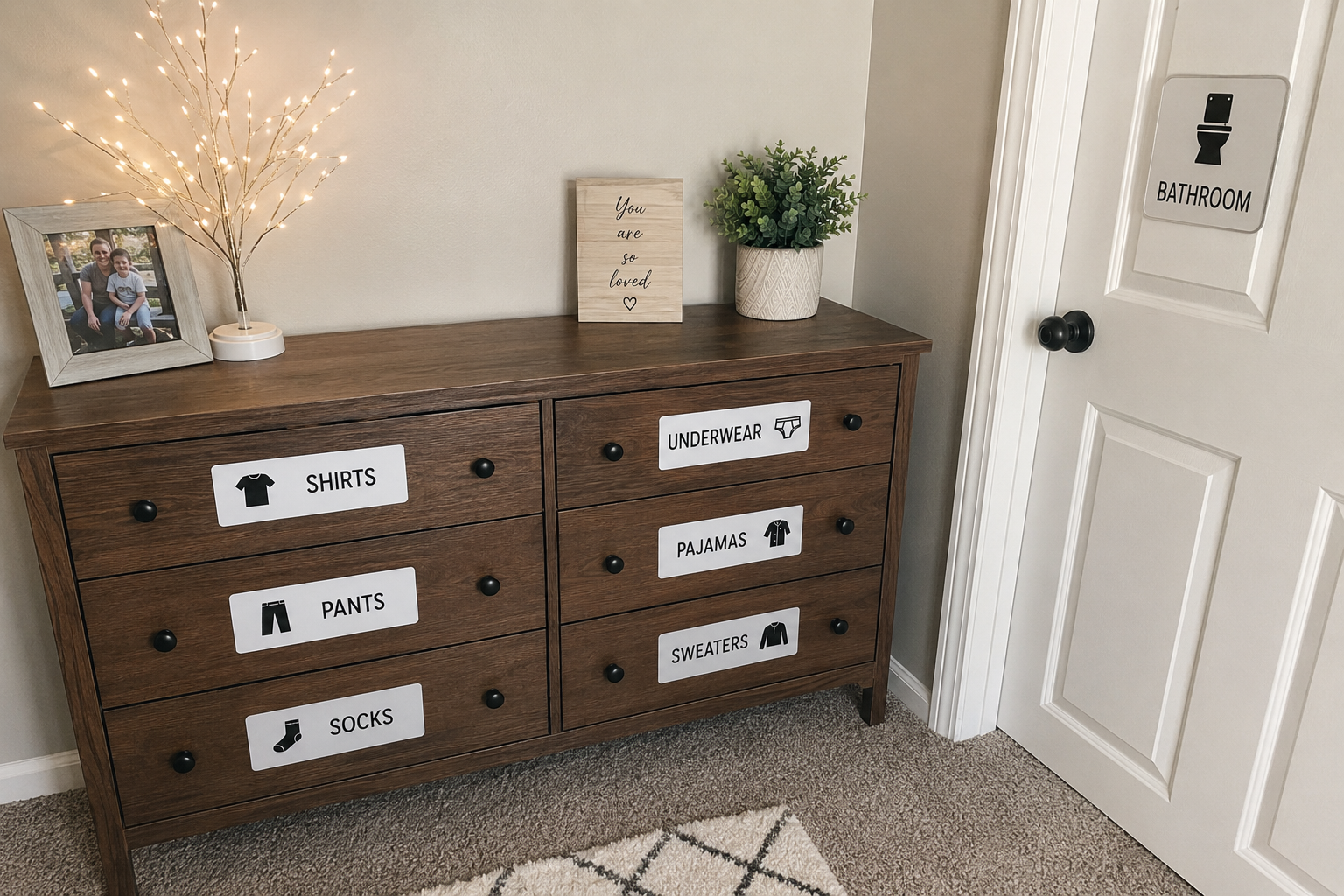
Another challenge is that many things begin to look alike. Imagine standing in a hallway with several identical doors and trying to determine which one leads to the bathroom, bedroom, or closet. What seems obvious to us may no longer be obvious to the person living with dementia. This is where simple cues like signs, family photos, memory boxes, or distinctive decorations can provide gentle guidance.

What Is a Cue?

A cue is simply something that helps a person understand where they are, what something is, what they are doing, or what comes next.

Think of a cue as a gentle reminder from the environment.

Not taking over.

Not doing the task for them.

Simply helping the brain make connections that may no longer happen automatically.

Set the Person Up for Success, Not for a Test

Sometimes what looks like inability is actually a lack of support.

A person may not be unable to find the bathroom. They may simply be unable to recognize an unmarked door.

A person may not be refusing to get dressed. They may be overwhelmed by too many clothing choices.

A person may not be unable to participate in an activity. They may simply need a visual cue to get started.

When we improve cueing, we often discover the person can do far more than we realized.

This is one of the most important principles in dementia care:

Set the Person Up for Success, Not for a Test.

The Goal Is Independence

Sometimes caregivers worry that cueing means doing everything for the person. In reality, the opposite is often true.

Good cueing helps preserve independence.

Every time the environment helps a person find an item, complete a task, participate in an activity, or make a choice, we are supporting retained abilities. We are creating opportunities for success rather than moments of failure.

Examples of Helpful Cues

Often, the simplest changes make the biggest difference.

A toothbrush left visible on the bathroom counter may encourage independent brushing. A favorite sweater displayed where it can be easily seen may make getting dressed easier. A family photo on a bedroom door may help someone find their room. A calendar, whiteboard, or daily schedule can provide reassurance about what comes next.

One of the most powerful cues is routine. When activities happen at roughly the same time and in the same order each day, the brain begins to anticipate what comes next. Predictability reduces uncertainty, and uncertainty often creates anxiety.

The environment can also help invite participation. Instead of explaining every step of an activity, try setting it up first. Put the puzzle on the table. Lay out the cards. Set the table before a meal. Place baking ingredients on the counter. The environment itself becomes a cue.

The Best Cues Are Personal

Not every cue works for every person.

The most effective cues are often meaningful to the individual.

A favorite family photo.

A beloved chair.

A treasured quilt.

A favorite coffee mug.

A lifelong routine.

A familiar song.

The brain often responds more strongly to things that are emotionally meaningful than to generic signs or labels.

Person-centered cueing is often the most successful cueing.

Often the most effective cues are not the most elaborate. They are simply the easiest to see, recognize, and connect with emotionally.

Reducing Moments of Failure

Many people living with dementia experience repeated moments of failure throughout the day.

They may forget a step.

Lose an item.

Become confused.

Struggle to find the right word.

Or feel uncertain about what comes next.

Thoughtful cues help reduce those moments of failure and replace them with opportunities for success.

And success matters.

Success builds confidence.

Success reduces frustration.

Success supports dignity.

Putting It Into Practice: This Week’s Action Steps

Action Item #1: Become a Cue Detective

Choose one daily activity your loved one completes each day.

As you observe, ask yourself:

☐ Are the items needed for the activity visible?

☐ Are important items hidden in drawers, cabinets, or closets?

☐ Are there too many choices creating confusion?

☐ Could a visual cue help?

☐ Is the person being expected to remember a step that the environment could support?

☐ Is there a way to make success easier?

Goal: Begin looking for ways the environment can support success rather than relying on memory alone.


Action Item #2: Complete a Cue Walkthrough

Walk through your home from the perspective of your loved one.

Ask yourself:

☐ Can they easily identify the bathroom?

☐ Can they easily identify their bedroom?

☐ Are important items within their visual field?

☐ Are frequently used items easy to find?

☐ Are there family photos or familiar objects that help with orientation?

☐ Are daily routines supported by the environment?

☐ Are there opportunities to simplify or reduce confusion?

Write down three opportunities to improve cueing in your home.

Then choose one simple change to implement this week.

Examples:

☐ Add a bathroom sign.

☐ Place a family photo on a bedroom door.

☐ Move frequently used items into view.

☐ Create a simple daily schedule.

☐ Reduce unnecessary clutter.

☐ Set up an activity before inviting participation.


This Week’s Reminder

Stop testing. Start cueing.

Don’t test the memory. Support the success.

Because dementia care is not about proving what someone can no longer remember.

It is about creating an environment that helps them use the abilities they still have.

And sometimes the smallest cue can create the biggest success.

💜

Next Week in Calm On Purpose: We’ll explore how familiarity, routines, and emotional safety help create environments where people living with dementia feel calm, confident, and connected.

ChatGPT-Image-Nov-11-2025-11_54_01-PM
Daily Life & Caregiving

The Senses Matter — Creating Environments That Feel Comfortable and Safe

A Person’s Sensory Environment Impacts Everything

When a person living with dementia feels overwhelmed, overstimulated, cold, uncomfortable, confused, or unable to focus, it impacts nearly every aspect of daily life.

Years ago, when I was working as a Regional Memory Care Director, I remember the early days of COVID vividly.

Like so many senior living communities across the country, we received the directive that residents needed to remain in their apartments as much as possible in order to reduce exposure and keep everyone safe.

And collectively, memory care teams everywhere found themselves asking the same question:

“How do you help residents who cannot remember the rule… stay in their apartments?”

Because the truth is, people living with dementia were not wandering the hallways to “be difficult.”

They were often trying to meet a need:
comfort, connection, movement, familiarity, stimulation, or reassurance.

So one of our communities came up with an incredibly thoughtful idea.

The team recognized something important:
people naturally gravitate toward environments that feel comfortable to their senses.

So instead of relying entirely on redirection or repeated reminders, the community adjusted the environment itself.

The hallway temperatures were lowered slightly.

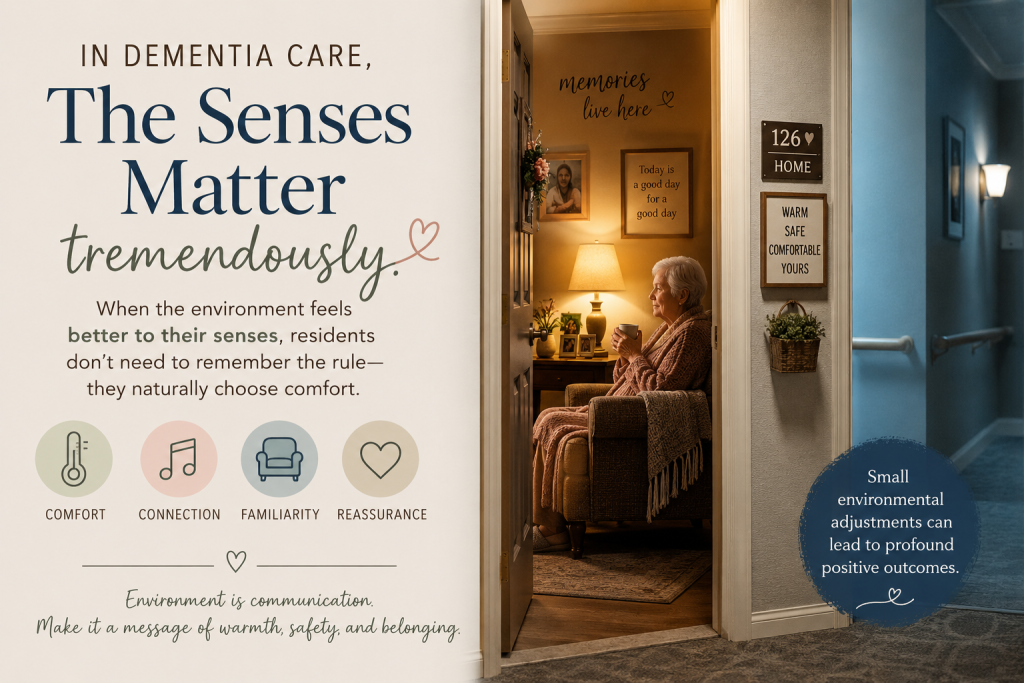
Resident apartments, meanwhile, were kept warm and cozy. Residents had familiar music playing, favorite blankets, meaningful personal belongings, comfortable seating, calming lighting, and person-centered items that reflected who they were.

Residents would open their apartment doors, feel the cool hallway air, and naturally choose to remain in the warm, comforting environment of their own apartment.

Not because they remembered the rule.

But because the environment itself felt better to their senses.

That moment stayed with me because it perfectly demonstrated something we do not talk about nearly enough in dementia care:

The senses matter tremendously.

Sensory comfort affects:

  • direct care
  • medication delivery
  • activity participation
  • dining experiences
  • communication
  • sleep
  • focus and attention
  • emotional well-being

Even something as simple as feeling cold can become a tremendous distraction.

If we are trying to help someone focus on eating, taking medications, participating in activities, or receiving care while their senses are overwhelmed, the brain may simply not be able to process everything successfully.

This is one reason dementia-friendly sensory environments are so important.

Sight: What The Person Sees Matters

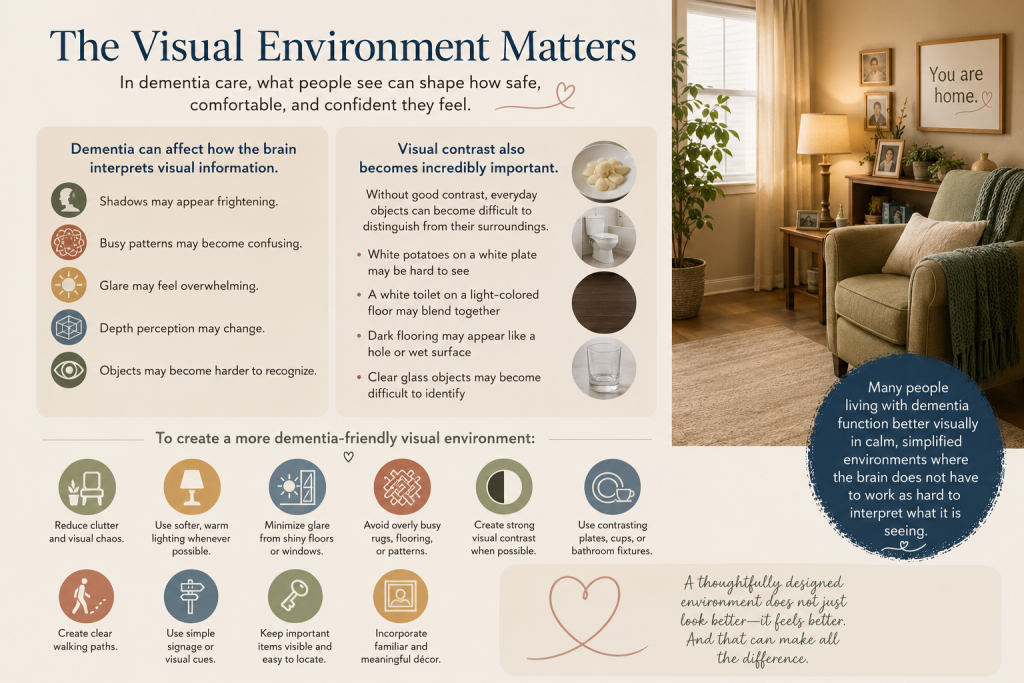
Dementia can affect how the brain interprets visual information.

  • Shadows may appear frightening.
  • Busy patterns may become confusing.
  • Glare may feel overwhelming.
  • Depth perception may change.
  • Objects may become harder to recognize.

Visual contrast also becomes incredibly important.

Without good contrast, everyday objects can become difficult to distinguish from their surroundings.

For example:

  • white potatoes on a white plate may be hard to see
  • a white toilet on a light-colored floor may blend together
  • dark flooring may appear like a hole or wet surface
  • clear glass objects may become difficult to identify
  • reduce clutter and visual chaos
  • use softer, warm lighting whenever possible
  • minimize glare from shiny floors or windows
  • avoid overly busy rugs, flooring, or patterns
  • create strong visual contrast when possible
  • use contrasting plates, cups, or bathroom fixtures
  • create clear walking paths
  • use simple signage or visual cues
  • keep important items visible and easy to locate
  • incorporate familiar and meaningful décor

Hearing: The Brain Often Cannot Filter Noise The Same Way

One of the biggest sensory challenges in dementia care is noise.

As dementia progresses, the brain may lose some ability to filter background sounds. This means every sound may compete equally for attention.

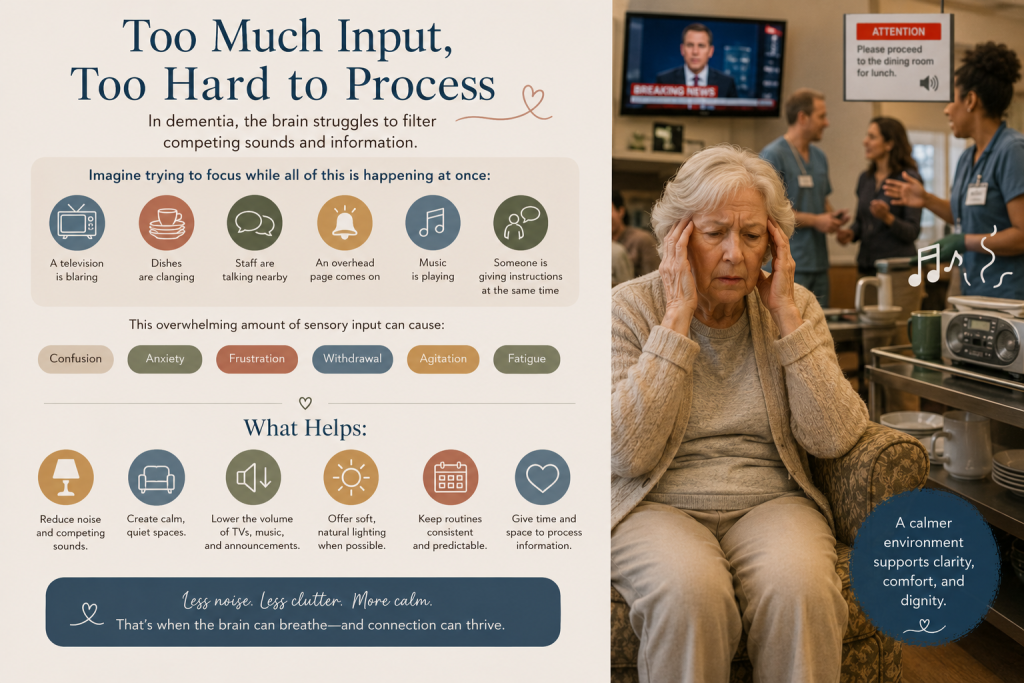
Imagine trying to focus while:

  • a television is blaring
  • dishes are clanging
  • staff are talking nearby
  • an overhead page comes on
  • music is playing
  • someone is giving instructions at the same time

For many people living with dementia, environments like this can feel mentally exhausting.

THE GOLDEN RULE:
NO COMPETING SOUNDS.

If music is playing, turn the television off.
If someone is trying to communicate, reduce background noise.
If residents are dining, avoid overwhelming sensory chaos whenever possible.

  • lower television volume
  • avoid multiple competing sounds at once
  • reduce unnecessary overhead paging
  • speak slowly and calmly
  • allow quiet spaces throughout the day
  • be mindful of loud dining environments
  • use familiar music intentionally and thoughtfully
  • reduce chaotic or rushed conversations around residents

Sometimes simply reducing noise can significantly reduce distress.

Temperature & Touch: Physical Comfort Is Essential

People living with dementia are often highly sensitive to physical comfort.

Something as simple as being cold, sitting in uncomfortable clothing, or feeling rushed during personal care can create enormous distress — especially when the person may no longer be able to explain what feels wrong.

And an important thing to remember:

Many older adults — particularly those living with dementia — are more sensitive to colder temperatures than caregivers or staff may realize.

  • keep environments warm and cozy
  • offer soft blankets or comforting textures
  • avoid rushing care tasks
  • pay attention to whether residents seem cold
  • create comfortable seating areas
  • use gentle approaches during hands-on care
  • consider lighting and temperature during bathing
  • recognize that physical discomfort may appear as “behaviors”

Many residents naturally gravitate toward spaces that feel physically safe and comforting to their senses.

Smell: Familiar & Comforting Scents Can Be Powerful

Smell is deeply connected to emotion and memory.

Certain scents may feel comforting and familiar:

  • coffee brewing
  • cookies baking
  • flowers
  • perfume
  • fresh laundry

At the same time, overwhelming or unpleasant smells can increase confusion, nausea, discomfort, or agitation.

  • maintain good air circulation
  • minimize strong chemical odors when possible
  • use familiar comforting scents thoughtfully
  • recognize that dining smells may stimulate appetite
  • avoid overwhelming fragrances
  • pay attention to how residents respond to different scents

Sometimes something as simple as the smell of fresh bread or coffee can help a space feel more welcoming, grounding, and familiar.

At Dementia Life STL, we believe dementia-friendly environments are not about perfection.

  • calm
  • comfortable
  • less overwhelmed
  • more successful
  • safe
  • supported
  • at home

When we begin looking at environments through the lens of the senses, we often realize just how much the world may be asking a person living with dementia to process every single day.

And sometimes, the smallest sensory changes can make the biggest difference.

Putting It Into Practice

As you walk through your home, memory care neighborhood, assisted living community, adult day center, or care setting this week, try viewing the environment through the eyes — and senses — of a person living with dementia.

And ask yourself:

Sight

  • Is this space visually calm or visually overwhelming?
  • Is there clutter, glare, or busy patterns?
  • Are important items easy to see and recognize?
  • Is there enough visual contrast between objects?
  • Would someone know where to walk or where to sit?
  • Does the lighting feel warm and comforting?

Hearing

  • Are there competing sounds happening at the same time?
  • Is a television on while music is playing?
  • Are staff conversations creating extra noise?
  • Would this space feel peaceful… or overwhelming?
  • Is there anywhere quiet to rest or regroup

Temperature & Touch

  • Does this space feel warm and comfortable?
  • Would someone sitting still likely feel cold here?
  • Are chairs comfortable and supportive?
  • Are blankets or sweaters available?
  • Does the bathing or shower area feel cold or clinical?

Smell

  • Does the environment smell welcoming and familiar?
  • Are there strong odors that could feel overwhelming?
  • Could comforting scents be incorporated thoughtfully?
  • Does the dining space smell appetizing and inviting?

Overall

  • Does this space feel calm?
  • Would I feel safe here if I were confused?
  • Would I know what to do next?
  • Would I want to stay here?
  • Does this environment support comfort… or create stress?

Sometimes the smallest changes make the biggest difference.

A quieter dining room.
A warmer temperature.
Gentle sounds.
Reducing clutter.
Softening the lighting.
Slowing the pace.

Dementia-friendly environments do not happen accidentally.

Small Steps This Week

Choose ONE sensory change to focus on this week.

Maybe:

  • reducing competing sounds during meals
  • offering warmer blankets
  • turning off a loud television
  • improving lighting in a hallway
  • simplifying a cluttered area
  • creating a quiet rest space
  • adding familiar music at calming times of day

Do not underestimate the power of small environmental changes.

Often, they are the very things that help a person living with dementia feel safe, successful, and at home.

Over the next few weeks in our Dementia-Friendly Environments series, we will continue exploring how to create environments that are safer, easier to navigate, emotionally supportive, and rooted in person-centered dementia care.

How We Do It Here June Week One
Resources & ToolsWorking with Dementia

How We Do It Here

A Professional Series on Building Better Dementia Care

June: Dementia-Friendly Environments in Senior Living & Care Settings

Why Environments Matter

At Dementia Life STL, we have the privilege of spending time in many senior living communities, memory care neighborhoods, adult day programs, and care settings throughout our region.

And we want to say something honestly, respectfully, and with tremendous hope:

Very few environments are truly dementia friendly.

Even in memory care.

Even in communities where families are paying thousands of dollars each month specifically for dementia support.

This is not said with judgment.

It is said because we believe our field can do better – and because we know firsthand that when environments improve, resident well-being improves too.

The truth is: many of the challenges communities struggle with every day are deeply connected to environment.

  • Noise
  • Overstimulation
  • Rushed care
  • Cold temperatures and drafts
  • Confusing layouts
  • Unfriendly or task-focused approaches
  • Lack of meaningful engagement
  • Too many instructions at once
  • Institutional pacing instead of human pacing

The environment matters far more than many organizations realize.

And when communities intentionally create dementia-friendly environments, we often see improvements in:

  • Distress behaviors
  • Dining success
  • Activity participation
  • Medication refusals
  • Cooperation during care
  • Sleep patterns
  • Staff stress levels
  • Family satisfaction
  • Overall resident quality of life

Because dementia does not just affect memory.

It affects how a person experiences the world around them.

The Environment Is Either Supporting the Brain – Or Working Against It

As dementia progresses, the brain may struggle to process background noise, busy visual environments, multiple conversations, complicated instructions, overstimulation, unfamiliar spaces, rushed interactions, and unpredictability.

What may feel normal to staff can feel exhausting, frightening, or overwhelming to a resident living with cognitive changes.

And often, what we label as:

  • “Noncompliance”
  • “Attention-seeking”
  • “Agitation”
  • “Wandering”
  • “Refusing care”
  • “Behaviors”

may actually be communication.

The resident may be saying:

“I’m overwhelmed.”

“I’m scared.”

“I’m so cold.”

“There’s too much happening.”

“I don’t understand.”

“I need more time.”

“I don’t feel safe.”

“My brain cannot process this environment.”

This is why dementia-friendly environments are not an “extra.”

They are clinical care.

And they affect nearly every outcome communities care about.

Before Anything Else, The Community Must Decide: “How We Do It Here”

Walk into almost any family home and you will often find signs on the walls that tell you what matters there.

“In this house, we laugh often.”

“Family is everything.”

“Be kind.”

“Gather here.”

“Bless this home.”

Those signs are not really decorations.

They are declarations.

They communicate the values, culture, and expectations of the people who live there.

Senior living communities should be no different.

Before changing lighting, dining rooms, sensory stimulation, routines, or care approaches, organizations first need to decide:

Who are we?

What do we stand for?

How do we want people to feel when they live here, work here, and visit here?

The communities that successfully create dementia-friendly environments almost always have a shared philosophy that sounds something like:

“In our home, we slow down.”

“In our home, residents come first.”

“In our home, emotional safety matters.”

“In our home, we connect instead of correct.”

“In our home, we create calm.”

“In our home, every person is treated with dignity.”

“In our home, relationships matter more than routines.”

“In our home, we work together.”

These statements may never appear on a decorative sign hanging on the wall.

But they should be visible in every interaction.

Because culture is not what an organization says.

Culture is what people experience.

And dementia-friendly care begins long before environmental changes are made.

It begins with deciding:

This is how we do it here.

That culture must come before the environmental changes.

Because without shared buy-in, dementia-friendly care becomes inconsistent from shift to shift, department to department, and person to person.

And yes, there may be pushback at first.

Some staff may say:

“We don’t have time.”

“This is unrealistic.”

“We’ve always done it this way.”

“Families don’t understand staffing challenges.”

“Residents just have behaviors.”

But when teams begin understanding the WHY behind dementia-friendly care, perspectives often begin to shift.

Research has repeatedly shown that person-centered dementia care environments are associated with improved staff satisfaction, reduced burnout, better teamwork, and improved quality of care.

Studies have also shown that staff who feel supported in delivering person-centered dementia care often experience greater professional fulfillment and stronger connection to their work.

And honestly, many caregivers entered this field because they wanted to help people feel safe, valued, and cared for – not simply complete tasks on a schedule.

How To Begin Changing the Environment

The first step is simple:

Include everyone.

Every single person who walks into memory care contributes to the environment residents experience.

Not just nursing.

Not just activities.

Not just leadership.

Everyone.

  • Dining staff
  • Housekeeping
  • Receptionists
  • Maintenance
  • Caregivers
  • Medication technicians
  • Nurses
  • Volunteers
  • Therapy staff
  • Executive directors
  • Agency staff

Everyone should understand:

  • How dementia changes the brain
  • Why environments matter
  • How sensory overload affects residents
  • How pacing and tone affect distress
  • Why residents may react the way they do
  • What supportive dementia care actually looks like

This cannot live only in annual training modules.

It has to become:

“How we do it here.”

Do This Exercise With Your Team

At your next staff meeting or town hall, try this exercise.

Turn on a television.

Play music in the background.

Have multiple staff members talk at once.

Then ask one employee to complete a task they are unfamiliar with while someone gives rapid instructions and corrects them impatiently.

Then add another layer:

Have them wear blurry glasses, sunglasses indoors, or goggles that distort their vision.

Afterward, ask:

“How did that feel?”

Most people describe feeling:

  • Anxious
  • Overstimulated
  • Frustrated
  • Pressured
  • Mentally exhausted
  • Distracted
  • Irritated
  • Confused

Now ask your team:

“What if this was your reality every day?”

That moment creates empathy.

And empathy creates buy-in.

And eventually, ownership and pride in the care being delivered and the community they help create.

Making It Stick: “How We Do It Here”

Dementia-friendly culture must become:

“How we do it here.”

That means:

  • Talking about it during interviews
  • Discussing it in orientation
  • Training consistently
  • Modeling it daily
  • Recognizing staff who do it well
  • Coaching staff who struggle
  • Holding teams accountable

Communities should be very clear during hiring about the type of dementia care culture they are building.

And accountability matters.

If a staff member consistently approaches residents with impatience, harshness, dismissiveness, or rushed care, that cannot simply be overlooked because “the tasks got done.”

Because in dementia care, how care is delivered matters just as much as whether the task was completed.

Families notice.

Residents feel it.

Staff culture reflects it.

And leadership sets the tone.

Start Small – One Change Each Week

Communities do not need to overhaul everything overnight.

In fact, the most sustainable change often happens gradually.

Challenge your team to improve just one thing each week.

Maybe this week:

Televisions are turned off during meals and calendar activities.

Next week:

We make comfort a priority and ensure temperatures are appropriate throughout the community.

The following week:

Staff focus on smiling, slowing down, and approaching residents with a gentle tone.

Then:

We create more predictable daily routines and transitions.

Small environmental shifts can create enormous changes over time.

And staff begin seeing firsthand:

“This really works.”

Become the Local Expert Families Trust

Families today are searching for communities that truly understand dementia.

Not just communities that provide supervision.

Not just communities with locked doors.

Families are looking for environments where their loved one will be understood, comforted, supported, and treated with dignity.

Communities that intentionally build dementia-friendly environments position themselves as leaders in their local area.

Not through marketing slogans.

But through culture.

Through outcomes.

Through resident well-being.

Through family trust.

And ultimately, that is what drives most of us into this field in the first place.

Not just occupancy.

Not just tasks.

But improving quality of life for people living with dementia.

At Dementia Life STL, we would love to help organizations build environments where residents — and staff — can truly thrive.

Because the best dementia care is not something we say.

It’s something people experience.

It’s simply…

How we do it here.

We’d Love to Help

If this article sparked ideas for your team, we’d love to continue the conversation.

Dementia Life STL offers a free Dementia-Friendly Environments Skill Builder and Staff In-Service Packet for organizations looking to begin improving their environment and culture.

We also provide no-cost staff trainings, caregiver education, community presentations, and our immersive Dementia Experience throughout the region.

Whether you’re just getting started or looking to take your dementia care to the next level, we’re here to help.

Reach out anytime – we’d love to connect.

📧 mary@dementialife.care
🌐 www.dementialife.care

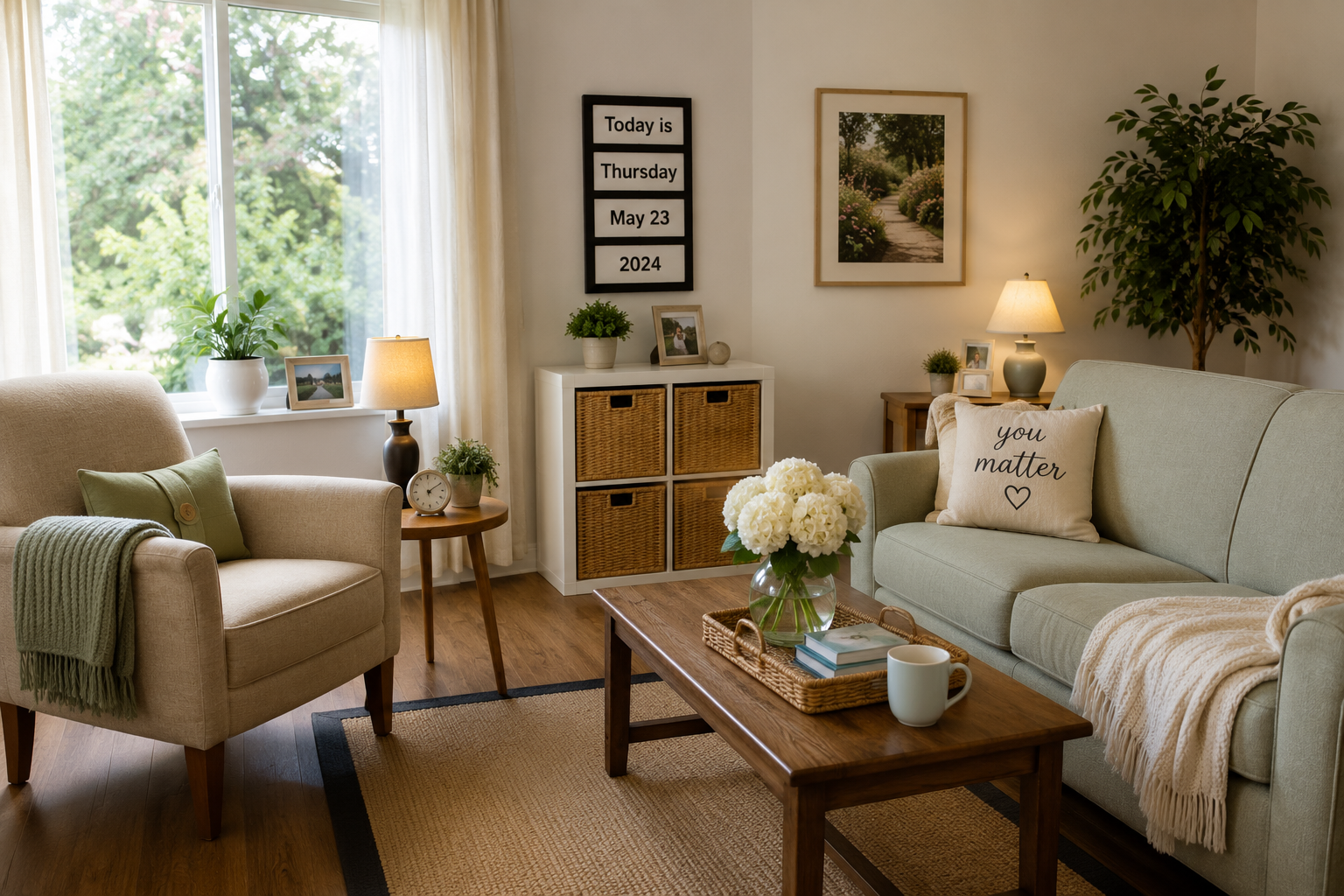
livingroom
Daily Life & Caregiving

When the World Starts to Feel Different: Why Environment Matters in Dementia Care

At Dementia Life, one of the most important things we want families, professionals, and communities to understand is this:

Dementia changes how a person experiences the world around them.

Not just memory.

Not just words.

The world itself may begin to feel different or harder to interpret.

As dementia progresses, the brain may gradually have more difficulty filtering background noise, processing multiple conversations at once, understanding busy environments, recognizing objects, processing information quickly, managing overstimulation, organizing steps and tasks, and understanding what comes next. Things that once felt automatic may slowly begin to require enormous mental effort.

And because of that, the environment itself becomes part of dementia care.

The Brain Is Working Harder Than We Realize

Imagine trying to focus while:

  • a television is blaring
  • dishes are clanging
  • multiple people are talking
  • someone is giving you instructions too quickly
  • bright lights are glaring overhead
  • you are unsure what you are supposed to do next
  • everyone around you seems rushed, impatient, or stressed

Now imagine you cannot fully process or organize all of that information anymore.

For many people living with dementia, this is happening every single day.

The brain is trying incredibly hard to make sense of an environment that may suddenly feel overwhelming, confusing, overstimulating, unpredictable, or emotionally unsafe.

And often, what we call “behaviors” are actually communication.

Sometimes the person living with dementia is saying:

  • “I’m overwhelmed.”
  • “I’m confused.”
  • “I’m cold.”
  • “I don’t understand what you want me to do.”
  • “There’s too much happening around me.”
  • “I’m frightened.”
  • “I’m uncomfortable.”
  • “I don’t feel safe.”
  • “I’m trying my best.”

That changes how we view dementia care entirely.

Because instead of asking:
“How do we stop this behavior?”

we begin asking:
“What is this person experiencing right now?”

An Exercise: Experiencing the World Through a Different Lens

We often encourage caregivers and professionals to try a simple exercise.

Turn on a television.
Then turn on music.
Ask someone nearby to talk to you while you attempt to complete a task you are unfamiliar with.
Now imagine someone giving you instructions quickly while becoming frustrated that you are not keeping up.

Then add another layer.

Put on a pair of goggles, blurry glasses, sunglasses indoors, or anything that changes or limits your vision while trying to complete the task.

Because dementia can also affect how the brain interprets visual information. Depth perception may change. Shadows may appear frightening. Patterns may become confusing. Objects may be harder to recognize. Glare and lighting may suddenly feel overwhelming.

Most people who try this exercise describe feeling anxious, overstimulated, mentally exhausted, pressured, distracted, irritated, or confused.

Now imagine living with those feelings while also struggling with memory changes, language changes, processing difficulties, or confusion about where you are.

This is why dementia-friendly environments matter so much.

Dementia-Friendly Environments Do Not Happen By Accident

This is incredibly important:

Dementia-friendly environments usually do not happen naturally.

In fact, they are often very different from environments we might naturally create for ourselves.

A person living with dementia may need less noise, slower pacing, simpler surroundings, fewer choices, softer lighting, more predictability, familiar music, reassurance, and calmer conversations in order to feel successful and safe.

Creating a supportive dementia environment requires intentionality.

It means putting the person living with dementia first.

Their comfort.
Their calm.
Their preferences.
Their abilities.
Their emotional safety.

Not what is easiest for everyone else.
Not what feels stimulating to us.
Not what creates the most efficiency.

The goal is helping the person living with dementia feel safe, loved, calm, successful, included, respected, and connected – whether at home, in assisted living, memory care, adult day, hospice, home care, or a hospital setting.

Small Changes Can Have a Powerful Impact

Sometimes families feel overwhelmed and assume they must completely transform their home or care setting.

But often, small changes make an enormous difference.

Lowering background noise.
Slowing down communication.
Turning off an overstimulating television.
Offering reassurance before instruction.
Playing familiar music.
Reducing clutter.
Creating predictable routines.
Approaching with a smile.
Making eye contact.
Helping the person feel included and empowered rather than managed.

These things matter more than many people realize.

At Dementia Life, we believe the environment should support the person – not constantly ask the person to struggle to adapt to the environment.

And that shift changes everything.

Over the next few weeks in our Dementia-Friendly Environments series, we are going to take a deeper dive into HOW to make these changes. Together, we will explore how to create environments that are:

  • safe and supportive
  • sensory friendly and calming
  • familiar and easier to navigate
  • full of meaningful cues and routines
  • emotionally supportive and reassuring

Because dementia-friendly environments are not about perfection.

They are about helping a person living with dementia feel safe, successful, understood, and loved.

Putting It Into Practice: This Week’s Action Steps

Action Item #1: Become an Environment Detective

For one day, pay attention to the spaces your loved one spends the most time in.

Ask yourself:

  • Is the television on even when no one is watching it?
  • Are multiple conversations happening at once?
  • Is there clutter competing for attention?
  • Are there loud or sudden noises throughout the day?
  • Are there times when the environment feels rushed, chaotic, or overwhelming?

Write down three things you notice. Don’t worry about fixing anything yet – just observe.

Goal: Begin seeing the environment through the eyes of the person living with dementia.

We Would Love to Help

If you are caring for a loved one at home, or if you are part of a senior living community, home care agency, adult day program, hospice team, healthcare setting, or memory care community, we would love to help you create more dementia-friendly environments.

Because people living with dementia deserve spaces that help them feel safe, understood, supported, and deeply valued.

And sometimes the smallest environmental changes can create the biggest difference in quality of life.

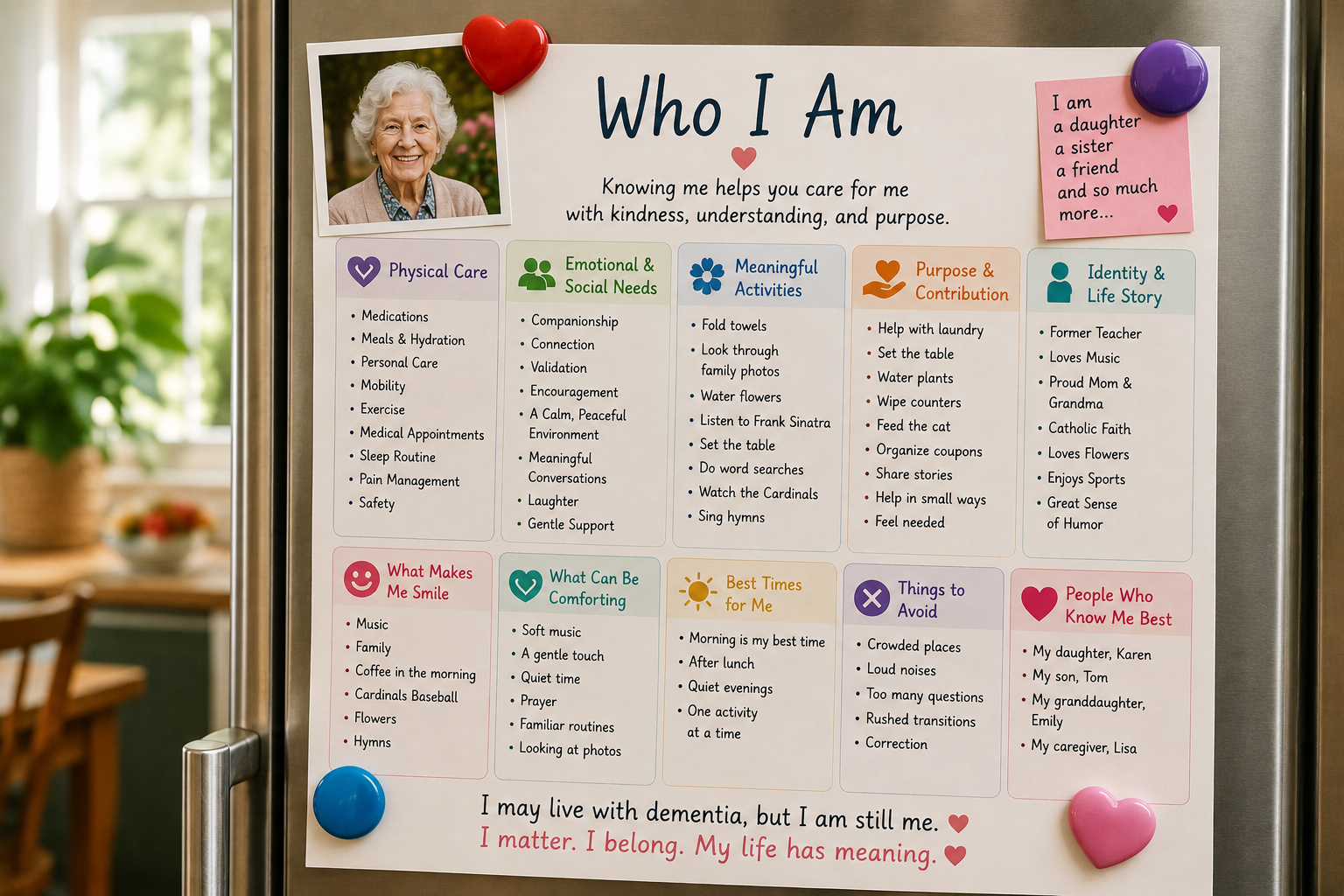
Who I Am
Daily Life & CaregivingEmotional & Spiritual SupportResources & Tools

Planting Purpose: Bringing Meaningful Engagement Into Everyday Life

Over the past several weeks in our May Flowers series, we have explored something we believe deeply at Dementia Life STL:

A meaningful life does not end with a dementia diagnosis.

We have talked about why activities are not simply “something to do.”
We have explored how meaningful engagement supports emotional well-being, reduces distress, and helps a person continue to feel connected to the world around them.

We have learned how to:

  • Adapt activities to match remaining abilities
  • Focus on strengths instead of losses
  • Create person-centered moments rooted in lifelong interests, routines, and identity
  • Preserve purpose, dignity, and joy at every stage of dementia

This week, we want to bring it all together.

Because eventually every family asks the same question:

“Okay… but how do we actually make this happen day to day?”

How do we move beyond good intentions and create a life that truly supports meaningful engagement on a regular basis?

At Dementia Life, our answer is simple:

Meaningful engagement should become part of the care plan – not an afterthought.

Because quality dementia care is about far more than medications, meals, and appointments.

It is about creating a life that still feels like life.


Every Person Living with Dementia Deserves More Than Physical Care Alone

When most people hear the words “care plan,” they think about:

  • medications
  • doctor appointments
  • bathing
  • safety concerns
  • mobility needs

And yes – those things matter tremendously.

But a person living with dementia is still a whole person.

Meeting physical needs keeps someone alive.

Meaningful engagement helps them live.

A truly supportive care plan should include both.


Meaningful Activities Belong in the Care Plan Too

Imagine a daily care plan that looks something like this:

8:00 AM – Breakfast
9:00 AM – Medications
10:00 AM – Fold towels while listening to Frank Sinatra
12:00 PM – Lunch
2:00 PM – Water flowers on the patio
4:00 PM – Look through family photo albums
5:30 PM – Help set the table
7:00 PM – Evening prayer and favorite hymns

This is not “keeping someone busy.”

This is preserving identity.
This is reducing boredom and isolation.
This is helping a person remain connected to familiar rhythms and meaningful roles.

And a care plan that includes those things helps everyone who is involved in the individual’s care have the same goal in mind.


Start Small

You do not have to transform the entire day overnight.

In fact, adding just two intentional, person-centered moments into your loved one’s daily routine is an incredible place to begin.

Ask yourself:

What is one familiar daily task that could help my loved one feel purposeful and included?

And:

What is one hobby, leisure activity, or simple pleasure they would genuinely enjoy?

That’s it.

Maybe it is:

  • folding towels
  • watering flowers
  • helping stir cookie batter
  • setting the table
  • feeding the dog

And maybe their leisure activity is:

  • listening to favorite music
  • sitting outside
  • looking through photographs
  • watching birds
  • reading scripture
  • completing a word search
  • watching an old western

Those moments may seem simple.

But simple does not mean insignificant.


Putting the Thoughts To Paper

Once you begin identifying meaningful activities, familiar routines, and purposeful roles, the next step is straightforward:

Write it down.

It does not need to be fancy.
It does not need to look clinical or professional.

In fact, sometimes the best care plans are the simplest ones.

It might be:

  • a notebook on the kitchen counter
  • a piece of paper taped to the refrigerator
  • a dry erase board
  • a binder shared between family members
  • a simple printed daily routine

What matters most is not perfection – it is having a plan.

When meaningful engagement stays only in our heads, it is easy for it to get lost in the stress and busyness of caregiving.

But when it is written down, it becomes intentional.

A written plan also helps create consistency between caregivers. Spouses, adult children, home care staff, volunteers, respite caregivers, and memory care staff can all better understand what brings comfort, what creates joy, what gives the person purpose, what activities are calming, what routines are familiar, and what helps the day go more smoothly.

Even something as simple as:

“After breakfast, Mary enjoys watering flowers and listening to gospel music”

can help transform the tone of the entire day.


You Do Not Have to Do This Alone

Caregiving can feel incredibly isolating, especially when all responsibility seems to fall on one person.

Invite others in.

Grandchildren can read stories or do crafts.
Church members can visit and sing hymns.
Neighbors can stop by for coffee.
Friends can look through photo albums together.
Volunteers can lead music, games, or art activities.

Sometimes all it takes is one caring visitor, one shared laugh, one familiar song, or one meaningful conversation to brighten an entire day.


If Your Loved One Lives in Assisted Living or Memory Care

Many families worry:

“The staff is already so busy.”

And that concern is understandable.

But families still play an incredibly important role in helping staff understand the person behind the diagnosis.

We encourage families to share:

  • preferred name
  • former occupation
  • favorite music
  • hobbies and interests
  • comforting routines
  • spiritual practices
  • favorite topics
  • activities they dislike
  • best times of day for engagement

The more staff members know about the individual, the more opportunities there are for truly person-centered care.

Families can also help create additional opportunities for engagement by:

  • leading a small music group
  • organizing sing-alongs
  • helping with gardening
  • coordinating intergenerational visits
  • recruiting volunteers
  • donating activity supplies
  • bringing in musicians, students, or community groups

One meaningful activity can ripple outward and touch many residents – not just your loved one.


The Goal Is Not Just Survival – It Is Quality of Life

At Dementia Life, we believe dementia care should never focus solely on preventing decline.

It should also focus on preserving life, connection, identity, and joy.

A strong care plan should answer two equally important questions:

How will we help meet this person’s physical needs?

AND

How will we help this person continue to experience meaning, purpose, comfort, and connection?

Because even in the midst of dementia, meaningful moments are still possible.

And those moments matter.


Need Help Creating a Dementia Care Plan?

If your family would like support creating a personalized dementia care plan, we would be honored to walk alongside you.

Learn more at Dementia Life STL.