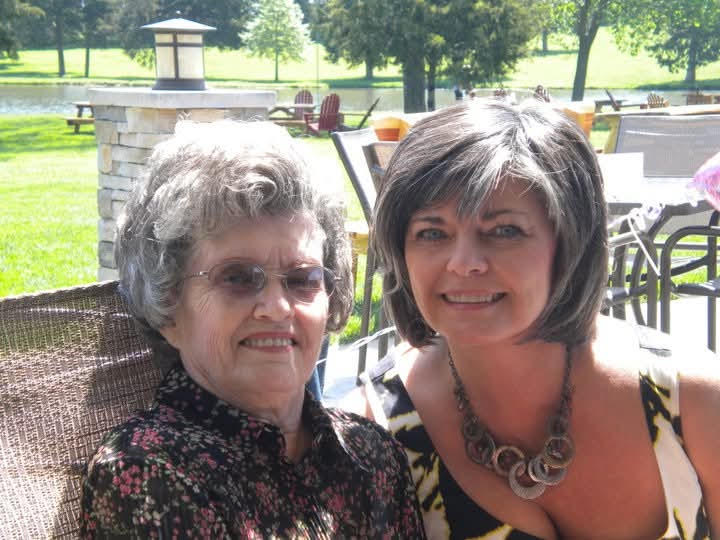
The Power of Yes: How I Learned to Step Into My Mom’s World
Who knew the 2016 Summer Olympics could help me figure out how to communicate with my mother.
I’ll get to that, but first, a little background.
My mother and I have never seen eye-to-eye and were great with arguments and eye rolls. When she was diagnosed with Alzheimer’s Disease around 2009, it got even harder. If you are reading this, I know you get it. Getting the same questions over and over again is exhausting, annoying, and infuriating. If you haven’t figured it out yet, the absolute worst thing you can do is say, “Mom, I just told you that three times in the last hour.”
Yep, trust me—it won’t work.
If your father (her husband) is an uber-high Type A and was in management his entire life, not having her remember or do what he said is also unpleasant.
My mother’s name was Fran. She stood 4’10½” at her tallest and weighed in at a solid 95 pounds for most of her life. She was a bundle of energy. She taught high school, and big football players cowed to her. Needless to say, she could hold her own and send you running with “that look.” She always said ‘dynamite comes in small packages,’ and Little Frannie proved that.
Fast forward to 2016.
She was hospitalized for something, probably an extreme UTI. While she was in the hospital, she was asking me about her friend Eustacius and whether she had decided to buy the house. I thought to myself, ‘who the heck is Eustacius, and what house are you talking about?’
I just kind of said I hadn’t talked to her and we moved on.
That was my first experience with Hospital-Induced Delirium. The National Institutes of Health defines it as “a temporary but severe form of mental impairment that can lead to longer hospital stays and negative long-term outcomes, commonly acquired by elderly patients in acute care settings. Up to a third of patients 70 years old and above experience delirium, and the rate is much higher for those in intensive care or undergoing surgery. Until recent decades, hospital-acquired delirium, which typically lasts anywhere from a couple of days to several weeks but can even last months, was chalked up to old age and not considered a condition to be prevented or treated.”
In layman’s terms, I would say it is like the “crazy” that comes with a UTI but multiplied maybe tenfold. In my experience, it cleared up the minute we got her out of the hospital environment.
Now, as to how the Olympics helped.
There was some controversy going on with the U.S. Swimming Team at the Rio Summer Olympics. Mother was in a rehab facility after the above-mentioned hospitalization and had a roommate who listened to the Olympics all day and night. This ended up burrowing into Mother’s head, and she felt certain the police were coming to arrest her because of some party and the damage that was done. She wanted to know
what my husband thought. I told her he knew nothing about it. I told her it was no big deal and I hadn’t seen any police around, so I was sure she didn’t need to worry.
After about three days, I finally walked out of the room for a little while and went back in and told her I checked with the nurses. They told me the police said they arrested the culprits and didn’t need to talk to her.
That was that. She was satisfied with that answer.
That was the moment when I realized that you need to get into the world of someone with dementia.
We feel so bad “lying” to our parents and loved ones, but we call it “situational fibbing” and, in my opinion, it is 100% acceptable. Think about it this way-Your loved one wants to go see their parents, who have been dead 20 years. What do you say? I always said they were on vacation for a couple of weeks. Why would you tell them they are dead and keep getting them upset every 15 minutes? I found out after she passed, when I started volunteering for the Alzheimer’s Association, that this is a key tip. Their reality IS reality. Meet them there. Have fun. I think of it like improv. Just go with what they are experiencing. I found through this that humor was a great way for us to connect. When she had a hard time saying a word, I would just say, “Well, that was easy for YOU to say,” and laugh. She would laugh and say, “Nope, not really.”
What I learned:
* You cannot control the situation.
* Get into their reality.
* Find some “canned” answers for those repetitive questions and use them until they don’t work anymore (a dementia patient will not remember you already told them.)
* Find a communication style that works for you and your loved one. Ours was humor.
* Find resources. There are so many good resources to use. Do not be afraid to ask for help.
* Take care of yourself. It’s like on a plane—put on your oxygen before you help someone else.
As frustrated as you get (you will and it is OK—it is a real emotion), remember that it is ultimately an honor to care for them and these are days and memories you will cherish.